
For the last few years, software companies have been locked in what feels like the world’s strangest arms race.
Who can add AI first?
Who can put the biggest AI button on the screen?
Who can cram an assistant, chatbot, copilot, writing helper, image generator, meeting summarizer and probably an AI-powered calculator into software that was already doing its job just fine?
Sometimes the results are genuinely impressive. I use AI myself, and there are absolutely things I can do today that would have taken me much longer just a few years ago.
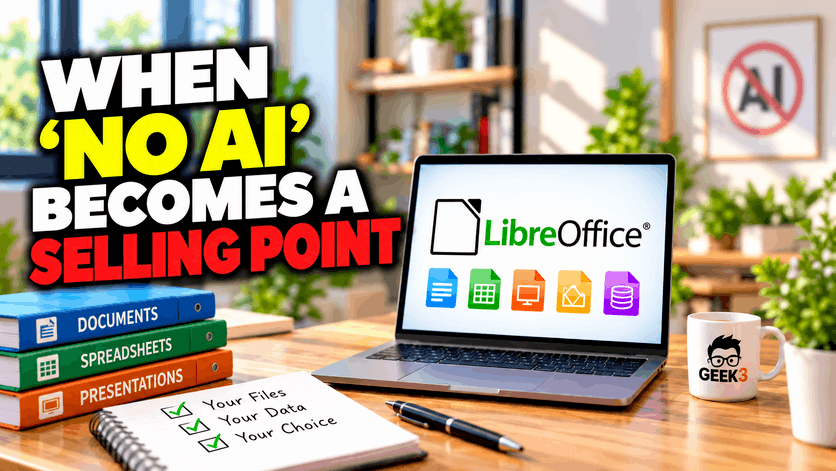
But we may have officially reached the point where not having AI has become a feature.
That is exactly what LibreOffice is now doing.
If you are not familiar with it, LibreOffice is a free and open-source office suite. Think Microsoft Word, Excel and PowerPoint, except the LibreOffice versions are called Writer, Calc and Impress.
The organization behind LibreOffice recently reiterated something that would have sounded bizarre a couple of years ago:
Their software does not contain built-in generative AI.
And they are doing that on purpose.
Not because they think artificial intelligence is evil.
Not because someone at LibreOffice smashed their router and moved into a cabin in Montana.
Their argument is much more practical.
They want users to know that when they open a document and start working, the software is not quietly sending the contents somewhere else for AI processing. It does not require an internet connection to work, and AI services are not embedded into the default product.
In other words, they are turning something most software companies would probably consider a missing feature into a selling point.
And I think that is a really interesting development.
Because this story is not really about LibreOffice.
It is about something much bigger happening with technology right now.
We have spent years assuming that more features automatically means better software.
AI may finally be forcing us to question that.
Somewhere Along the Way, We Decided Everything Needed More Stuff
Technology companies love adding things.
Sometimes those additions are fantastic.
A new feature can save hours of work, automate something annoying or make an old piece of software dramatically easier to use.
But there is another side to that.
Sometimes features get added simply because competitors have them.
Or because marketing needs something exciting to put on the website.
Or because somebody in a meeting asked:
“Can we put AI in this?”
Then everybody nodded because apparently asking why would ruin the meeting.
We have all seen this happen outside of software too.
Think about buying a refrigerator.
You walk into the store because your old refrigerator died and you need somewhere to keep milk cold.
Simple enough.
Then you discover that refrigerators now have giant touchscreens, Wi-Fi, cameras, smartphone apps, voice assistants and probably a social media account.
At some point I fully expect my refrigerator to send me a push notification saying:
“Erik, based on your recent cheese consumption, I have some concerns.”
Guys.
I just wanted my milk cold.
There is absolutely nothing wrong with adding technology when it solves a problem. The problem starts when the existence of a technology becomes the justification for adding it.
That distinction matters.
AI is particularly susceptible to this because it is currently one of the hottest areas in technology.
Put “AI-powered” in front of almost anything and suddenly it sounds futuristic.
AI-powered accounting.
AI-powered customer service.
AI-powered email.
AI-powered cybersecurity.
AI-powered toothbrush.
I made that last one up.
Actually, I should probably check before saying that because somebody has probably already made one.
The result is that businesses are increasingly surrounded by software that includes AI whether they deliberately went looking for it or not.
And that is where things get more complicated.
Because AI is not simply another button sitting inside a program.
Depending on how that feature works, clicking that button may involve sending information somewhere else.
The Important Question Is Not “Do You Use AI?”
There is a strange conversation happening in business right now.
Some companies are proudly announcing that they use AI.
Others are banning it.
Employees are experimenting with it on their own.
Executives are asking how the company can use more of it.
IT departments are trying to figure out what everyone has already signed up for.
Meanwhile, every software vendor seems to have discovered that adding the word “AI” to an existing product allows them to create a new pricing tier.
But I think businesses are asking the wrong first question.
The question should not be:
“Does our company use AI?”
That is becoming almost meaningless.
A much more useful set of questions would be:
What AI are we using?
What information are we putting into it?
Where does that information go?
Who has access to it?
How long is it kept?
And what controls do we actually have over all of this?
Those questions are a lot less exciting than watching an AI write an email in six seconds.
They are also much more important.
LibreOffice specifically pointed to organizations working with confidential, legally privileged or personal information.
Think about how much sensitive information exists inside ordinary business documents.
Employee information.
Tax records.
Medical information.
Customer lists.
Contracts.
Banking details.
Passwords someone unfortunately typed into a spreadsheet named PASSWORDS-FINAL-NEW.xlsx.
You know that file exists somewhere.
Probably right next to PASSWORDS-FINAL-NEW2.xlsx.
For decades, businesses have been trained to think about protecting files from outsiders.
We install firewalls.
We use antivirus software.
We restrict user accounts.
We create backups.
We use multifactor authentication.
We tell employees not to click the email from “Microsoft Security Department” asking them to verify their password within 17 minutes or their mailbox will explode.
Then along comes a shiny AI button.
And someone copies an entire confidential document into it without even thinking twice.
That is a very different kind of security problem.
Imagine Hiring the Smartest Employee You Have Ever Met
Here is the analogy I keep coming back to.
Imagine you hire a new employee.
This employee is incredible.
They can write reports.
Summarize contracts.
Analyze spreadsheets.
Draft emails.
Brainstorm ideas.
Translate languages.
Create presentations.
They work unbelievably fast.
They never complain.
They never take lunch.
And depending on the service, they may cost less than your monthly coffee budget.
You would probably think you had hit the employee lottery.
Except there is one little detail.
Every time you give this employee a document, they may take it out of your office, drive it across town to another company, work on it there and then bring the result back.
Suddenly you have some questions.
Where exactly are you taking that document?
Who works there?
Are they making copies?
How long do they keep it?
Can somebody else see it?
Is it being used for something else?
Can I prevent certain employees from doing this?
Those would be perfectly reasonable questions.
Yet when information leaves a computer electronically, it is much easier to forget that the same questions still apply.
The file did not physically walk out the front door.
Nothing disappeared from the desk.
There was no guy carrying a cardboard box labeled CONFIDENTIAL into the parking lot.
The employee clicked a button, waited a few seconds and got a helpful answer.
From their perspective, nothing unusual happened.
That is precisely why businesses need to understand how these tools work.
This does not mean every cloud-based AI tool is automatically unsafe.
It means that businesses need to know what they are using before feeding important information into it.
There is a massive difference between using an AI system specifically configured for business data and an employee casually creating an account somewhere because they needed help rewriting a proposal.
The technology may look almost identical from the employee’s perspective.
The policies behind it may be completely different.
This Is Where LibreOffice’s Decision Gets Interesting
LibreOffice could have gone the other direction.
They could have added a big colorful AI button.
They could have released “LibreOffice Copilot Ultra Intelligence Max” and created a subscription plan.
Instead, they effectively said:
Not yet.
The organization has said it is not opposed to artificial intelligence in general. Users can even install extensions that connect LibreOffice to AI tools if they want.
But AI is not part of the default installation.
Their reasoning centers around user control, privacy and the ability to keep documents on the local device.
That is what makes this more interesting than simply saying “LibreOffice refuses AI.”
They are not necessarily rejecting the technology.
They are rejecting the idea that AI automatically belongs inside the product.
There is a difference.
And I suspect we are going to see more of this.
For the last couple of years, software companies have been advertising how much AI they can add.
Eventually, some companies are going to start advertising how much control they give you over it.
That may become especially important in industries handling sensitive information.
Healthcare.
Legal.
Financial services.
Government.
Education.
Accounting.
Insurance.
Basically anywhere that “Oops, I uploaded that to the wrong thing” can become a very expensive sentence.
And businesses may begin paying closer attention to whether AI features can be disabled entirely.
That sounds almost backwards.
But security often works that way.
Sometimes the most valuable capability a system can have is the ability to not do something.
Your Printer Does Not Need a Personality
There is another part of this conversation that has less to do with privacy and more to do with common sense.
Not every piece of technology needs artificial intelligence.
I am fully prepared to die on this hill.
Your printer does not need a chatbot.
Your network switch does not need to compose poetry.
Your calculator does not need to ask how your day is going.
There are plenty of places where AI makes tremendous sense.
There are also plenty of places where the best interface is still:
Click button.
Thing happens.
Done.
Businesses should be careful not to confuse innovation with complexity.
One of the most common things I see working with businesses is technology that has slowly accumulated over time.
Someone installs an application.
Then another application.
A new service gets added.
Another account gets created.
A browser extension appears.
Someone signs up for a free tool.
An employee leaves, but their account stays.
Five years later nobody remembers why half of it exists.
AI can accelerate this problem because adopting AI tools is incredibly easy.
You do not need to install a server.
You do not need a giant IT project.
You may not even need a credit card.
An employee can discover a tool in the morning and be uploading company information into it by lunchtime.
That is both one of AI’s greatest strengths and one of its biggest management challenges.
Shadow IT Just Got Much Smarter
IT people have had a term for this problem for years:
Shadow IT.
That is basically technology being used inside a company without whoever manages the technology knowing about it.
Years ago, shadow IT might have meant someone installing Dropbox because they wanted an easier way to share files.
Or someone creating a personal Gmail account for work.
Or an employee installing random remote-access software because they wanted to work from home.
Those things still happen.
But AI has created an entirely new generation of shadow IT.
Someone wants help writing something.
They open an AI website.
Someone wants a spreadsheet analyzed.
They upload it.
Someone wants meeting notes summarized.
They connect a service to their calendar.
Someone wants an inbox assistant.
They authorize access to their email.
All of this can happen without malicious intent.
That is important.
Most employees are not trying to create security problems.
They are trying to get their jobs done.
If a tool saves them 45 minutes, of course they are interested.
That is exactly why simply telling everyone “Don’t use AI” is probably not a sustainable strategy for most businesses.
People will use useful tools.
A better strategy is deciding which tools are acceptable and creating reasonable boundaries around them.
That might mean approved AI platforms.
It might mean restricting certain types of information.
It might mean configuring business versions of tools instead of allowing personal accounts.
It might mean disabling features that are unnecessary.
It might mean training employees about what should never be uploaded.
And yes, sometimes it might mean saying:
“Nope. We don’t need AI in this particular thing.”
That should be a perfectly acceptable answer.
New Does Not Automatically Mean Better
One of the dangers of technology marketing is that it constantly makes businesses feel behind.
You are supposed to have the newest operating system.
The newest cloud platform.
The newest cybersecurity software.
The newest AI assistant.
The newest everything.
Otherwise, apparently, a competitor with six employees and a ChatGPT subscription will destroy your entire company by Tuesday.
Reality is usually less dramatic.
Good technology decisions are rarely about having the most stuff.
They are about choosing tools that solve actual problems.
I have walked into businesses with incredibly expensive technology that was configured terribly.
I have also seen businesses using relatively simple systems that were secure, reliable and perfectly matched to what they needed.
Guess which one I prefer?
The boring system that works.
Boring technology is underrated.
A backup that quietly runs every night is boring.
Multifactor authentication is boring.
A properly configured firewall is boring.
Software updates are boring.
A computer that turns on Monday morning and simply works is very boring.
Until one of those things fails.
Then suddenly boring becomes extremely exciting.
AI should be evaluated the same way.
If it saves time, improves accuracy, automates repetitive work or helps employees do their jobs better, fantastic.
Use it.
But if the only reason a feature exists is because somebody wanted the AI logo on the product page, maybe you do not need it.
There Is Also Such a Thing as Too Much Convenience
Convenience is one of technology’s greatest selling points.
It is also frequently the reason people bypass security.
Passwords are inconvenient.
Multifactor authentication is inconvenient.
Waiting for permission to install software is inconvenient.
Not being able to access every company file from every device on Earth is inconvenient.
Security and convenience have always been in a bit of a tug-of-war.
AI adds another layer to that.
The easier we make it to hand information to an AI system, the less likely someone is to think about what is happening behind the button.
That is not necessarily a criticism of AI companies.
Good software is supposed to feel easy.
But easy interfaces can hide complicated systems.
When someone copies text into an AI chat window, it feels a lot like typing something into Microsoft Word.
The experience is simple.
The infrastructure behind those two actions may be completely different.
Word processing software traditionally manipulates a file sitting on your machine or in your company’s cloud storage.
An AI request may involve transmitting that information to external systems for processing.
Again, that is not automatically bad.
Cloud computing has worked this way for years.
The important part is understanding it.
The problem is not sending information to another server.
The problem is sending information somewhere when nobody realized that was happening.
The Future Probably Is Not “AI Everywhere”
I think we are currently in the awkward phase of a major technology shift.
Whenever something new becomes popular, everyone experiments with it.
Companies rush to add it.
Some applications are brilliant.
Some are ridiculous.
Eventually the excitement settles down and the technology finds the places where it actually belongs.
Remember when everything needed an app?
Restaurants wanted apps.
Local stores wanted apps.
Your toothbrush probably wanted an app.
For a while, downloading a separate application for every business interaction was supposed to be the future.
Eventually everyone realized that sometimes a website works perfectly fine.
AI will probably follow a similar path.
There will absolutely be AI everywhere.
But I suspect there will also be plenty of software where AI quietly disappears because nobody actually needed it.
And there will be products where having no built-in AI becomes an advantage.
That is what makes the LibreOffice announcement interesting.
It may be an early example of another phase in this technology cycle.
Instead of asking:
“How much AI can we add?”
Companies may eventually ask:
“Where does AI actually make sense?”
That is a much healthier question.
Businesses Need a Little Bit of AI Boringness
The conversation around artificial intelligence tends to swing between two extremes.
One side says AI will change absolutely everything and anyone who does not immediately embrace it will become technologically extinct.
The other side treats AI like opening the Ark of the Covenant in an Indiana Jones movie.
Maybe we can land somewhere in the middle.
AI is useful.
Very useful.
It is also technology.
And technology should be managed.
You do not give every employee administrator access to every computer because computers are useful.
You do not connect every device directly to the internet because networking is useful.
You do not give every employee access to every company file because cloud storage is useful.
You put boundaries around technology.
AI should be no different.
Businesses should know what employees are using.
They should understand what happens to company information.
They should decide which tools are appropriate.
They should have some basic policies.
And they should be willing to turn off features they do not need.
None of that is particularly exciting.
There is no robot involved.
There is no futuristic animation.
There is no glowing blue brain floating above a laptop.
It is mostly good technology management.
Which is admittedly not going to make a great science fiction movie.
But it makes for a much safer business.
Sometimes the Best Feature Really Is the One You Leave Out
That is why I like the message behind what LibreOffice is doing.
It is not really:
“AI is bad.”
It is more like:
“We are not adding this until we are comfortable with how it fits into what our software is supposed to do.”
There is something refreshing about that.
Software does not automatically become better because the feature list gets longer.
Your business does not automatically become more advanced because employees are using six different AI tools.
And your technology does not automatically become more secure because someone put the word “enterprise” on the login screen.
Good technology should be intentional.
Sometimes that means adopting something brand new.
Sometimes it means replacing something old.
Sometimes it means locking something down.
And occasionally it means looking at the newest shiny feature everyone else is adding and saying:
We actually don’t need that.
That is not falling behind.
That is knowing what your business needs.
And that is a big part of what I do for businesses.
I help companies figure out what technology actually makes sense for them, secure the systems they already depend on, protect their data, manage access, keep their computers running and put some sensible guardrails around all the new technology constantly finding its way into the office.
Because the goal should never be to have the most technology.
The goal is to have technology that makes your business better without quietly creating three new problems behind the scenes.
If you would like some help figuring out whether your technology is actually doing that, shoot me a message.
I’m always happy to talk.
