
There are software updates… and then there are those software updates.
You know the kind.
The ones where the company quietly slips in a few bug fixes, maybe adds a new emoji nobody asked for, and your phone suddenly moves one button somewhere weird just to keep life interesting.
Then there are the updates where the company practically grabs you by the shoulders and says:
“No seriously. Install this. Now.”
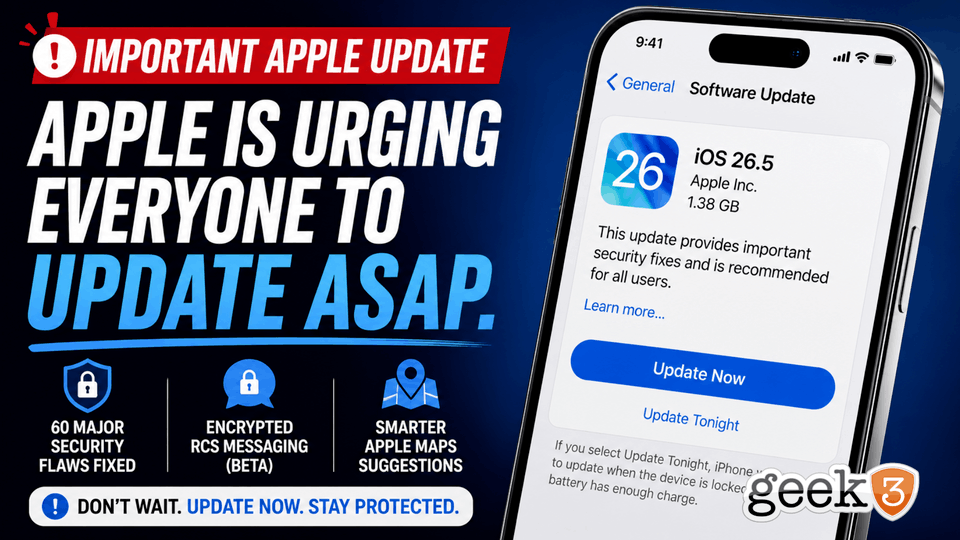
That’s what Apple just did with iOS 26.5.
And if you have an iPhone, this is one of those updates you should stop procrastinating on.
Apple recently released iOS 26.5 and patched roughly 60 security vulnerabilities in a single update.
Sixty.
That’s a huge number, even by modern standards.
And while Apple is usually pretty measured in how it communicates these things, the tone surrounding this update is noticeably more urgent than normal.
Translation?
This isn’t routine maintenance.
This is Apple trying to get ahead of a problem before bad actors fully capitalize on it.
Your iPhone Is More Important Than You Think
A lot of people still think of their phone as… well… a phone.
Maybe some texting.
A few photos.
A little social media doomscrolling before bed.
But your smartphone stopped being “just a phone” a long time ago.
Your iPhone now holds:
- Your email
- Banking apps
- Saved passwords
- Authentication prompts
- Business conversations
- Cloud storage access
- Personal photos
- Contact lists
- Payment information
- Access to other devices
For many people, their phone is effectively the master key to their entire digital life.
That’s why these updates matter.
Because modern cyberattacks are no longer just about stealing a single file off a computer somewhere.
Attackers want access to you.
Your accounts.
Your identity.
Your business.
Your contacts.
Your financial information.
And your phone sits right in the middle of all of it.
The Number That Should Get Your Attention
The biggest headline here is simple:
Apple fixed around 60 security vulnerabilities in one update.
That’s not a tiny patch.
That’s not “minor improvements.”
That’s more like discovering your house has 60 windows open during hurricane season and trying to slam them shut before the storm gets worse.
Some of the vulnerabilities reportedly involved:
- Safari’s WebKit engine
- Kernel-level access inside iOS
- App sandbox protections
- Malicious web content handling
Now if those terms sound technical, here’s the simplified version:
Some of these flaws could potentially allow malicious apps or websites to do things they absolutely should not be able to do.
That’s the important part.
And while Apple says there’s no confirmation these flaws were actively exploited yet, cybersecurity researchers pay very close attention to updates like this because they reveal where weaknesses existed.
Which leads to the next problem.
Cybercriminals Read Patch Notes Too
One of the biggest misconceptions people have is thinking software updates happen after hackers are gone.
That’s not really how this works.
The moment Apple releases security patches, researchers and attackers alike start analyzing them to understand exactly what changed.
It becomes a race.
People who update quickly close the door.
People who delay leave the door cracked open longer.
Imagine your neighborhood suddenly getting a notice that burglars discovered a flaw in a popular front door lock.
Some homeowners immediately replace the lock.
Others say:
“I’ll get to it later.”
Guess which houses become more attractive targets.
That’s essentially what software patching looks like in cybersecurity.
And the gap between “vulnerability discovered” and “vulnerability exploited” keeps shrinking.
AI Is Accelerating Everything
Here’s the part that should probably concern businesses the most.
Researchers are increasingly warning that AI is changing the speed of cybersecurity entirely.
And honestly, this was inevitable.
AI helps security researchers identify weaknesses faster.
But it also helps cybercriminals automate attacks faster.
It’s like both sides suddenly got access to power tools.
Years ago, attackers often had to manually probe systems, write custom code, and spend a lot of time targeting victims.
Today?
Automation does a huge portion of the work.
Attackers can rapidly scan devices, identify outdated software, generate convincing phishing messages, and adapt attacks at speeds that would have sounded ridiculous a decade ago.
Meanwhile, most people are still ignoring update notifications because they’re waiting for their phone battery to hit 100%.
The pace mismatch is becoming a real problem.
“But I Thought iPhones Were Secure?”
They are.
Generally speaking, iPhones are among the most secure consumer devices available.
But there’s a huge misunderstanding buried inside that statement.
People hear:
“iPhones are secure.”
What they should hear is:
“Apple works aggressively to KEEP iPhones secure.”
Those are two very different things.
Security is not a permanent condition.
It’s an ongoing process.
The reason Apple devices maintain a strong security reputation is because Apple continuously patches vulnerabilities, locks down systems, and pushes updates rapidly across supported devices.
That last part matters a lot.
In the Android world, updates are often fragmented across manufacturers and carriers. Apple has an advantage because it controls the hardware and software ecosystem tightly.
But none of that helps if people refuse to install the updates.
Owning a secure device while ignoring critical patches is a little like buying the safest car on the market and then deciding seatbelts are optional.
Why Businesses Should Care
A lot of small business owners assume cybercriminals only go after giant corporations.
Not true.
Small businesses are targeted constantly.
In many cases, they’re actually more attractive because attackers assume smaller organizations have:
- Weaker security
- Slower updates
- Poor password practices
- Less monitoring
- Smaller IT teams
- Lower cybersecurity awareness
And honestly?
Sometimes they’re right.
One compromised phone can create major problems.
Especially if that device has access to:
- Company email
- Shared cloud storage
- Financial systems
- Client communication
- MFA approvals
- CRM platforms
- Password managers
That’s why cybersecurity is no longer just about protecting “the office computer.”
Your business security perimeter now lives in everyone’s pocket.
The Psychology Of Update Procrastination
People have a weird relationship with software updates.
Everybody knows they matter.
Almost nobody wants to deal with them.
Updates feel inconvenient.
People worry:
- “What if my battery gets worse?”
- “What if something changes?”
- “What if an app breaks?”
- “What if I don’t like the new layout?”
And to be fair, sometimes those concerns are legitimate.
We’ve all had that one update that made us immediately wonder if the software engineers were fighting each other in the parking lot before release day.
But here’s the reality:
The risk of delaying major security patches is usually far greater than the risk of temporary annoyance.
Especially with updates like this one.
This isn’t Apple tweaking the weather widget.
This is Apple patching dozens of security vulnerabilities at once.
The Internet Is Not A Safe Neighborhood
One thing I think people underestimate is just how aggressive modern internet threats have become.
Most attacks aren’t dramatic.
Nobody is sitting in a dark basement individually targeting random people one by one like some movie villain.
Modern cybercrime is automated at scale.
Bots scan the internet constantly looking for:
- Unpatched devices
- Weak passwords
- Exposed systems
- Vulnerable browsers
- Old software versions
The process is relentless.
Think of it less like a burglar checking one house… and more like millions of robotic door handles being tested every second across the internet.
That’s why patching matters.
Not because you’re personally important to hackers.
But because vulnerable systems become easy targets inside massive automated sweeps.
The Safari Concern
One of the more concerning parts of this update involves WebKit, the engine powering Safari.
Web browser vulnerabilities are especially dangerous because browsers interact directly with outside content all day long.
You click a website.
An ad loads.
A script runs.
Content gets rendered.
That creates opportunity.
Researchers noted that some WebKit vulnerabilities could potentially involve maliciously crafted web content.
That’s cybersecurity language for:
“A bad website could potentially cause problems.”
And historically, browser vulnerabilities have been some of the most actively targeted attack vectors across all platforms.
Why?
Because everyone uses a browser.
It’s one of the most universal attack surfaces that exists.
Apple Also Added Some Good Stuff
Not everything in iOS 26.5 is doom and gloom.
Apple also introduced support for encrypted RCS messaging in beta for supported carriers.
That’s actually a pretty meaningful improvement because messaging between Android and iPhone users has historically lacked the same end-to-end encryption protections available in iMessage.
So while everybody loves focusing on the security panic angle, there are also some legitimate usability and privacy improvements here too.
Apple Maps also received enhancements, including suggested places features.
But let’s be honest.
Nobody is installing this update because of map suggestions.
This is a security update wearing a feature-update costume.
The “I’ll Do It Later” Problem
One of the biggest challenges in cybersecurity is that people don’t feel urgency until after something bad happens.
You can warn people for months.
But nothing creates instant motivation quite like:
- a compromised email account
- fraudulent charges
- ransomware
- locked files
- leaked passwords
- hacked social media accounts
Cybersecurity is weird because success often looks invisible.
If updates are working properly, nothing dramatic happens.
That’s the goal.
The absence of disaster is the win.
But because nothing visibly explodes, people underestimate how important routine maintenance really is.
What You Should Actually Do
Thankfully, this one is simple.
If your iPhone supports iOS 26.5:
Install it.
Tonight.
Go to:
Settings → General → Software Update
That’s it.
You don’t need to become a cybersecurity expert.
You just need to stop treating update notifications like unread terms and conditions.
Final Thought
One of the hardest parts about cybersecurity is that most threats don’t feel urgent until it’s too late.
Apple just released one of the largest iPhone security patch rollouts we’ve seen in a while.
That deserves attention.
Because while Apple engineers are working around the clock to close vulnerabilities, cybercriminals are working just as hard to exploit the people who fall behind.
And in today’s world, staying secure often comes down to boring little habits done consistently:
Updating devices.
Using MFA.
Avoiding sketchy links.
Keeping systems monitored.
Not assuming “it won’t happen to me.”
That’s the stuff that prevents disasters.
And if your business wants help staying ahead of security threats like this, that’s exactly what we do. From proactive monitoring and cybersecurity protection to keeping devices updated and secure, we help businesses reduce risk before small problems become expensive emergencies.
If you’d like help tightening up your company’s technology and cybersecurity posture, shoot me a message.
