
I feel like I’m taking crazy pills.
Over the past few years, we’ve watched one of the most aggressive technology movements in recent memory unfold right in front of us. Artificial intelligence went from an interesting tool to the center of nearly every business conversation seemingly overnight. Every conference, every webinar, every software vendor, every consultant, and every business publication started delivering the same message:
You need AI.
You need it now.
And if you’re not investing in it, you’re already behind.
The message was so loud and so constant that many organizations stopped asking whether AI made sense for their business and started asking how quickly they could implement it.
That’s when things started getting weird.
Businesses began restructuring around AI. Hiring slowed. Departments were consolidated. Entry-level opportunities started disappearing. Workers were told that the future would require fewer people because software would handle more of the workload.
Some companies embraced the change cautiously.
Others dove into the deep end wearing concrete shoes.
The justification was always the same. AI would make organizations leaner, faster, and more efficient. The savings would be enormous. The productivity gains would be revolutionary. Entire categories of work would become automated.
If you questioned any of it, you were often treated like someone arguing against the internet in 1995.
The future had already been decided.
At least that’s how it was presented.
Then reality did what reality always does.
It showed up uninvited.
As it turns out, replacing human beings is significantly harder than replacing individual tasks. AI can generate a draft. It can summarize information. It can help organize ideas. It can automate repetitive processes. It can absolutely create value.
But it also makes mistakes.
Confident mistakes.
Sometimes spectacular mistakes.
Somebody still has to verify the output. Somebody still has to make judgment calls. Somebody still has to take responsibility when things go wrong. Somebody still has to understand context, politics, customer relationships, regulations, exceptions, edge cases, and all the messy details that make businesses function in the real world.
The reality is that AI didn’t replace human expertise.
In many cases, it simply changed the nature of the work.
Instead of creating everything from scratch, people now spend more time reviewing, correcting, validating, and directing the output of AI systems.
That’s still work.
It’s different work, but it’s work nonetheless.
For a while, it seemed like businesses were beginning to understand this. The conversation started shifting from “AI will replace workers” to “AI will help workers.” That felt like progress. It felt like the market was correcting itself.
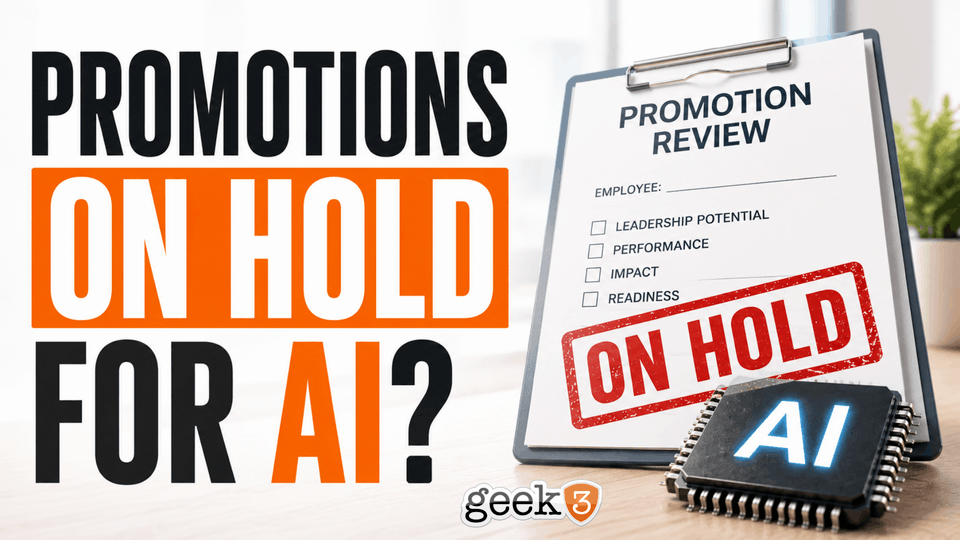
Then I came across reports that some companies are now delaying raises, slowing compensation growth, or redirecting employee investment because those funds are being moved into AI initiatives.
And I had the same reaction many people probably had.
Wait.
Didn’t we just learn this lesson?
Because that’s really what bothers me about this entire conversation.
It’s not AI itself.
It’s the pattern.
The pattern is what concerns me.
We’ve seen this movie before.
A new technology arrives. The promises are massive. The projections are optimistic. The excitement becomes contagious. Businesses become afraid of being left behind. Budgets get shifted. Plans get rewritten. Employees are asked to adapt. Sacrifices are justified in the name of future gains.
Then the technology delivers some value, but rarely the level of value that was promised.
That’s not because the technology is bad.
It’s because human beings are exceptionally good at overestimating short-term impact while underestimating long-term reality.
We’ve done this repeatedly.
The dot-com boom.
The cloud rush.
Big data.
Blockchain.
Cryptocurrency.
The metaverse.
Every one of these technologies created real value somewhere.
Every one of them also attracted enough hype to power a small city.
AI is following the exact same pattern.
Now before anyone rushes to the comments, let me be clear.
I am not anti-AI.
Not even close.
I use AI regularly. I think it’s useful. I think it’s here to stay. I think many businesses can benefit tremendously from it when it’s implemented thoughtfully and realistically.
The issue isn’t whether AI has value.
The issue is whether organizations are becoming so obsessed with AI that they’re forgetting where value actually comes from.
Because here’s the uncomfortable truth.
Most businesses don’t succeed because of technology.
They succeed because of people.
Technology helps.
Technology amplifies.
Technology accelerates.
But people create the relationships. People solve the problems. People calm frustrated customers. People identify opportunities. People navigate uncertainty. People adapt when the unexpected happens.
Technology is incredibly important.
But technology has always been a multiplier.
It’s not the foundation.
The foundation is still people.
That’s why these stories about compensation being sacrificed for AI strike a nerve.
They send a message whether leadership intends it or not.
The message isn’t “we’re investing in the future.”
The message employees hear is “the future is more important than you.”
That’s a dangerous message.
Imagine being a dedicated employee who survived layoffs. You adapted to new tools. You learned new systems. You embraced the company’s technology initiatives. You continued delivering results.
Then you’re told that compensation adjustments are being paused because the company needs additional funding for AI.
How are you supposed to feel about that?
Excited?
Motivated?
Inspired?
Probably not.
More likely, you’re going to start viewing AI as a competitor instead of a tool.
And that creates a problem.
Technology adoption works best when employees see it as something that helps them succeed. It works worst when employees view it as something that’s being prioritized above them.
That’s not an AI problem.
That’s a leadership problem.
One of the biggest mistakes organizations make is assuming employees view decisions the same way executives do.
Executives see budget allocations.
Employees see priorities.
Executives see strategic investments.
Employees see who gets rewarded and who doesn’t.
Executives see a technology roadmap.
Employees see whether their contributions matter.
Those aren’t the same thing.
You can tell employees that AI spending is necessary for the future all day long. But if that spending comes at the expense of promotions, raises, benefits, or career growth, don’t be surprised when people begin questioning the strategy.
The irony is that many organizations need their employees more than ever right now.
AI isn’t reducing the need for experienced workers.
In many cases, it’s increasing it.
The more AI gets integrated into business processes, the more important human oversight becomes. Somebody needs to know when the output is wrong. Somebody needs to recognize when context is missing. Somebody needs to understand when a recommendation sounds reasonable but would create a disaster in the real world.
That requires experience.
It requires judgment.
It requires people.
The technology industry spent years talking about replacing workers and is now discovering that many of those workers were carrying far more value than anyone realized.
Institutional knowledge doesn’t live inside software.
It lives inside people.
Customer trust doesn’t live inside software.
It lives inside people.
Accountability doesn’t live inside software.
It lives inside people.
And yet somehow we keep ending up in situations where the workforce becomes the first place companies look when they need funding for the next big initiative.
Need to improve margins?
Look at payroll.
Need to reduce expenses?
Look at payroll.
Need to fund a new project?
Look at payroll.
Need more money for AI?
You can probably guess where this is going.
At some point, organizations need to ask themselves a difficult question.
Are we investing in AI to strengthen our people?
Or are we investing in AI instead of our people?
Those are very different strategies.
One creates stronger organizations.
The other creates resentment.
The companies that seem to be getting AI right understand something important.
The goal isn’t fewer people.
The goal is better outcomes.
They aren’t using AI to eliminate every human interaction possible. They’re using AI to reduce repetitive work, improve efficiency, accelerate research, and free employees to focus on higher-value activities.
That’s where AI shines.
Not as a replacement for human capability.
As an enhancement to human capability.
That’s a much healthier way to think about it.
Because despite everything that’s happened over the last few years, one fact remains stubbornly true.
Businesses are still run by people.
Customers still buy from people.
Problems still get solved by people.
Relationships are still built by people.
Trust is still earned by people.
And when things go sideways, people still want to talk to another person.
Not a chatbot.
Not an algorithm.
Not a language model.
A person.
Maybe that’s the lesson we keep forgetting.
Technology should support people.
People shouldn’t be sacrificed to support technology.
That’s not an anti-AI statement.
It’s a pro-business statement.
The organizations that thrive over the next decade won’t be the ones that blindly chase every new technology trend. They’ll be the ones that learn how to combine powerful technology with talented people.
That’s always been the formula.
And I suspect it always will be.
At Geek3, we spend a lot of time helping businesses evaluate new technologies, cybersecurity solutions, cloud platforms, and emerging tools like AI. The question we always come back to is simple: does this actually improve the business?
Not the marketing pitch.
Not the hype.
Not the fear of missing out.
The business.
If you’re trying to determine where AI genuinely fits into your organization, or if you’re looking for practical technology guidance that keeps both productivity and people in mind, feel free to reach out. We’d be happy to help.
