
If you use Cox Internet around Gainesville, you may have received an interesting email recently.
Cox is now Spectrum.
Okay. Easy enough.
Except there is one tiny detail that makes this whole thing considerably more confusing.
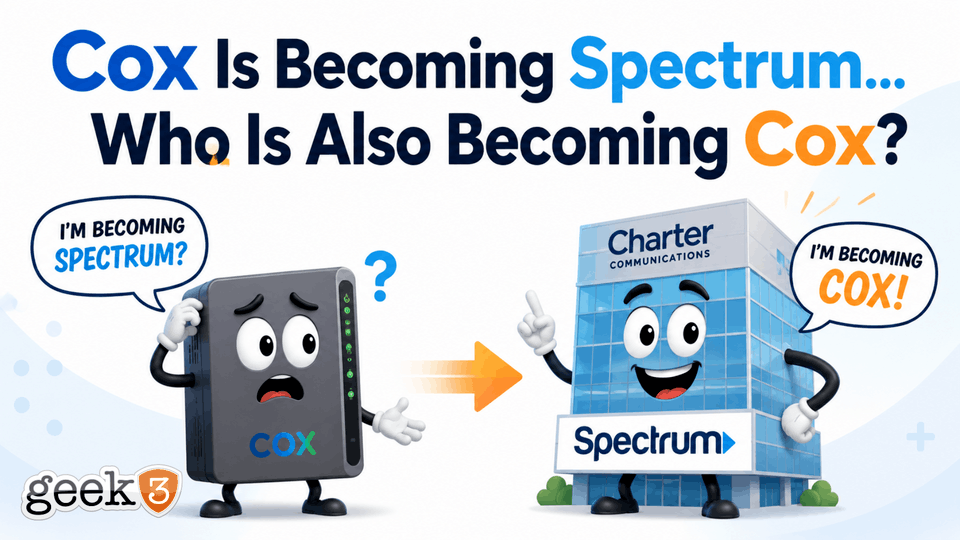
Within the next year, Charter Communications, the company behind Spectrum, plans to change its corporate name to Cox Communications.
So Cox is becoming Spectrum, while the company that owns Spectrum is becoming Cox.
Glad we got that cleared up.
Technically, Spectrum itself is not changing its name to Cox. Spectrum will remain the name customers see on internet service, mobile service, television, business accounts and eventually their bills. It’s the giant corporate parent sitting above Spectrum that will eventually take the Cox Communications name.
Which means, sometime next year, you could theoretically be a former Cox customer buying Spectrum Internet from a company called Cox Communications.
I’m sure there was a conference room full of very expensive people who decided this made perfect sense.
The naming gymnastics are funny, but the deal behind them is enormous. Charter Communications completed its acquisition of Cox Communications on August 20, bringing Cox’s millions of customers into the company that already operates Spectrum. Spectrum now says its brand, products, packages and pricing will begin rolling out throughout former Cox markets in mid-September.
For Gainesville, this isn’t some distant Wall Street story.
Cox has been part of the internet landscape around here for decades. A huge number of homes and businesses rely on Cox connections every day, and I have personally spent more hours dealing with Cox modems, outages, static IP addresses and business internet accounts than I would ever care to calculate.
So naturally, people want to know what happens now.
Is the internet changing?
Are prices changing?
Do we need different equipment?
Is Spectrum better than Cox?
Will your Cox modem burst into flames at midnight when the logo officially changes?
Let’s start with the easiest one.
Probably not.
The Biggest Change Right Now Is the Name
Despite the size of this merger, your internet connection isn’t suddenly becoming something completely different.
Spectrum isn’t planning to roll through Gainesville in September, tear all of Cox’s cable out of the ground and replace it with magical Spectrum cable.
The coax running into your house doesn’t know that a $34.5 billion corporate deal just happened.
Your modem doesn’t care either.
The physical network Cox built is now part of the larger company, and that existing infrastructure is going to continue carrying your internet.
For businesses, Cox has specifically told customers that existing equipment and configurations remain in place. Current contracts remain intact. Existing pricing and contractual terms remain intact. Phone numbers, account access, billing and existing support channels aren’t suddenly changing either.
For the moment, you’re basically getting a new name attached to the same connection.
And honestly, I think that’s good news.
Business internet is one of those things where boring is wonderful.
If your connection is working, you generally don’t want somebody showing up on Tuesday afternoon announcing that everything is about to become exciting.
Exciting internet is usually bad internet.
Businesses Have More Riding on This Than Most People Realize
At home, changing an internet connection might mean reconnecting a television, changing a Wi-Fi password or listening to your kids announce every seven seconds that the internet is down.
At a business, things can get considerably more interesting.
Your internet connection may have static IP addresses attached to it. Your firewall may depend on those addresses. Remote employees may connect through a VPN. Your phone system, security cameras, alarm system, credit card processing, cloud applications or remote access systems may all be quietly using that connection.
Nobody thinks about those things when they’re working.
That’s exactly how we like it.
So when Spectrum’s new plans start appearing, business owners need to be careful about treating this like changing a Netflix subscription.
If somebody from Spectrum eventually calls and says they can give you twice the speed for $30 less per month, great. Let’s look at it.
But don’t immediately say yes because the number on the brochure is bigger.
First, figure out what you have.
Then figure out what they’re actually changing.
A cheaper internet bill isn’t much of a victory if the person making the change accidentally eliminates a static IP address your business has depended on for six years.
I’ve seen enough “simple changes” to internet service turn into considerably less simple afternoons.
So… Is Spectrum Better Than Cox?
This is where things get entertaining.
I’ve spent some time reading reactions from Cox and Spectrum customers around the country, and the internet has once again done what it does best.
Reached absolutely no consensus whatsoever.
There are Cox customers celebrating as if someone just liberated their neighborhood.
There are Spectrum customers basically offering those people condolences.
Some longtime Cox customers say their internet has been incredibly reliable for years. Others talk about high prices, data limits and waiting desperately for a fiber provider to finally reach their street.
Spectrum gets almost exactly the same treatment.
Some people say they’ve had Spectrum for years without any major problems. Others describe Spectrum with words I’m probably not going to put on a business blog.
One online comment basically summed up the entire debate by asking whether Spectrum sucks worse than Cox.
That’s cable television and internet customer satisfaction in a nutshell.
Personally, I’m not ready to call Spectrum some white knight riding into Gainesville to save us from Cox.
Spectrum is a very large cable company.
Cox was a very large cable company.
Now one very large cable company has become part of another very large cable company.
Maybe let’s give them a little time before organizing the parade.
But There Are Some Things I Actually Like
Being skeptical doesn’t mean everything about this deal is bad.
There are some potential improvements worth watching.
One of the big ones for residential customers is data usage.
Cox has been criticized for years for data limits in many markets, while Spectrum has generally offered residential internet without those same monthly data caps.
If Spectrum’s plans remove that frustration for Cox customers around Gainesville, that’s a real improvement.
Not a marketing improvement.
An actual one.
Spectrum is also preparing to roll out its own plans, pricing and product packages throughout former Cox markets beginning in mid-September. Existing Cox customers don’t have to immediately move to one of those plans, but they’ll begin having the option.
That could create some legitimately interesting choices.
Some customers may find a Spectrum plan that is cheaper.
Others may get more download speed.
Some may benefit from unlimited data.
Spectrum is also offering qualifying Cox Internet customers who don’t already have Cox Mobile a free mobile line for a year.
All of that sounds pretty good.
Just don’t stop reading at the giant number on the advertisement.
If You Have a Good Cox Plan, Don’t Touch It Just Yet
This may be the most useful thing in this entire article.
When the new Spectrum plans start appearing, you do not need to immediately change anything.
Current Cox customers are being allowed to keep their existing plans, pricing and products. Spectrum’s own transition information specifically says customers who prefer to keep things as they are can do exactly that.
That’s important because internet pricing is weird.
Really weird.
Two neighbors can have basically the same service from the same cable company and somehow pay completely different amounts.
One signed up during a promotion.
The other called threatening to cancel three years ago.
Someone else has a grandfathered plan.
Another person bundled something.
Someone’s promotional price expired.
Someone else called customer service on a Tuesday when Mercury was in retrograde and somehow got gigabit internet for $47.
There are Cox customers online right now comparing their existing plans with some of the new options and discovering that “new” doesn’t always mean “better.”
One person found that making a change to remove an unlimited-data add-on would also interfere with an existing discount and actually increase the final bill.
Another customer compared new pricing with an older Cox plan and noticed that the newer option had significantly slower upload speeds.
That’s not evidence that Spectrum’s plans are bad. Those are individual customer experiences in different markets.
But they illustrate something important.
Compare the whole plan.
Download Speed Isn’t the Only Number That Matters
Internet companies love advertising download speeds.
500 Mbps!
1 Gig!
2 Gig!
MORE GIGS THAN YOUR NEIGHBOR!
And download speed absolutely matters.
But it’s only part of the connection.
Upload speed can be particularly important for businesses because that’s the direction your data is traveling when you’re sending large files, backing things up to the cloud, hosting remote connections, uploading video or using certain cloud applications.
A plan that gives you 1,000 Mbps down but dramatically reduces your upload speed might not actually be an upgrade for your particular business.
You also need to look at promotional periods.
What does that shiny introductory price become next year?
Is equipment included?
Are there additional charges?
Does changing plans affect something you already negotiated?
Do you lose an existing discount?
For business accounts, does the new plan include the same service-level expectations, static IP options or other features?
None of this means you should be scared of changing plans.
Just don’t change one because the salesperson said the word “gigabit” three times.
What Happens to Prices Later?
This is probably the question everyone really wants answered.
Will Spectrum eventually raise Cox customers’ prices?
I have no idea.
Neither does the guy confidently answering that question in your neighborhood Facebook group.
Spectrum says existing Cox pricing and contracts are remaining intact for customers who keep their current services. That’s good.
What happens several years from now as contracts expire, promotions end and more customers migrate onto Spectrum pricing?
We’ll find out.
I’m not going to pretend Spectrum has announced some secret plan to jack up everybody’s bill, because it hasn’t.
But I’m also not going to pretend that combining two enormous telecommunications companies guarantees an exciting future of endlessly decreasing internet bills.
I’ve been doing this too long for that.
What I would rather see is more competition.
Competition Is Usually the Interesting Part
Something jumped out at me while reading comments from Cox customers in different cities.
A lot of people talked about suddenly getting much better offers once fiber competition arrived in their neighborhood.
Funny how that works.
When your choices are:
Cox.
Or significantly slower internet.
Cox doesn’t exactly have to fight for your affection.
When another provider comes down the street offering fiber, suddenly everybody remembers where they put the promotional pricing.
This is why I’m more excited about additional fiber expansion around Gainesville than I am about the merger itself.
Spectrum may turn out to offer fantastic service here.
I hope it does.
But healthy competition between providers is generally better for customers than simply having one giant provider become even larger.
If AT&T, IQ Fiber, Pavlov Media or another fiber provider expands into an area and Spectrum suddenly has to compete hard for every customer, everybody benefits from that pressure.
Better prices.
Better speeds.
Better service.
Fewer opportunities for a cable company to look at your address and essentially say, “Where else are you going to go?”
The Network Isn’t Necessarily Standing Still Either
There’s another nuance here that is easy to miss.
Saying the existing Cox infrastructure remains in place doesn’t mean Spectrum will never upgrade it.
Charter has spent years upgrading its network and expanding the capabilities of cable infrastructure, and there is plenty of room for the former Cox network to evolve over time.
That’s particularly important because traditional cable has historically had a big weakness compared with fiber: upload speeds.
Cable technology is improving, and providers have been deploying network upgrades that allow substantially faster upstream speeds than older systems could deliver.
That doesn’t mean Gainesville wakes up next month with symmetrical multi-gigabit service everywhere.
I wouldn’t start ordering celebratory balloons.
It just means “same infrastructure” shouldn’t be interpreted as “nothing will ever improve.”
Spectrum now owns an enormous physical network that it has every financial incentive to continue modernizing.
We’ll see what that looks like locally.
One Change I Genuinely Hope Works Out
There is one part of this deal that I’m pretty happy about.
Customer support.
Spectrum says its customers are supported by U.S.-based employees, and Cox’s offshore sales and customer service operations are supposed to transition back to the United States over the next 18 months.
That wasn’t merely tossed into the welcome email. The commitment to bring those Cox operations back to the U.S. was part of the merger approval process with the FCC.
Anyone who has spent an afternoon dealing with a cable company knows why I’m interested in this.
You call because the internet is down.
You explain the problem.
You get transferred.
You explain it again.
Another transfer.
You explain it again.
Eventually someone asks whether you’ve tried restarting the modem, which is especially fun when you called to report that a dump truck physically ripped the cable off the side of the building.
Will moving customer service operations automatically eliminate frustrating support calls?
Of course not.
There are plenty of U.S.-based people capable of transferring you to the wrong department too.
But if Spectrum follows through and builds a more consistent support organization across the combined company, I’ll happily put that in the positive column.
Then There’s “Spectrum Day”
You may see people online talking about something called “Spectrum Day.”
There has been chatter about specific September dates, but the official announcement I’ve seen only commits to the broader timeframe of mid-September for Spectrum’s products, pricing and packaging to launch throughout former Cox markets.
So I’m not circling a specific day on my calendar just yet.
Whenever that rollout happens locally, that’s when this transition becomes more visible.
You’ll begin seeing Spectrum products marketed in places where Cox used to be the familiar name.
Over time, websites, stores, account systems, support operations, bills and other customer-facing parts of the company will increasingly become Spectrum.
Eventually, Cox as the service brand disappears.
Which brings us back to the funniest part of this entire story.
Goodbye Cox. Welcome Back, Cox.
Remember how Cox is becoming Spectrum?
Well, after all of that work removing the Cox name from customer-facing services, Charter plans to rename the parent corporation Cox Communications within a year.
Spectrum will still be Spectrum.
Your Spectrum bill will say Spectrum.
Spectrum Internet will still be Spectrum Internet.
Spectrum Business will still be Spectrum Business.
But the corporate company behind all of that will eventually be named Cox Communications.
Charter’s own FAQ spells this out directly: the parent company changes to Cox Communications, while Spectrum remains the consumer-facing name customers see on products, bills and service.
Why?
The Cox family and Cox Enterprises remain a major part of the combined company’s ownership after the transaction, so there is corporate logic behind keeping the Cox name at the parent level.
But from the perspective of somebody who just wants the internet to work?
It’s objectively funny.
Imagine explaining this a year from now.
“Who provides your internet?”
“Spectrum.”
“Who owns Spectrum?”
“Cox.”
“Oh, so you still have Cox?”
“No. Cox became Spectrum.”
“But Cox owns Spectrum?”
“Yes.”
“So Cox didn’t become Spectrum?”
“Well…”
At that point just unplug the modem and go outside.
Is This Merger Good for Gainesville?
Ask me again next year.
There are reasons to be optimistic.
Spectrum may introduce plans that are cheaper or more flexible for some customers. Residential customers may benefit from plans without Cox-style data limits. Network investments may eventually improve speeds and capabilities. Bringing customer service operations back to the U.S. could turn out to be a meaningful improvement.
There are also reasons not to get carried away.
This is a huge consolidation in an industry that already isn’t famous for intense competition in every neighborhood. Spectrum isn’t automatically better because the logo is new, and nobody should assume every new package will beat every old Cox plan.
The good news is that we don’t have to make that decision today.
Your existing service isn’t suddenly disappearing.
Your current plan doesn’t have to change.
Your Cox Business contract doesn’t evaporate because somebody signed a merger agreement.
And the cable running into your building will continue blissfully unaware of every corporate decision happening several levels above it.
For now, that’s probably exactly what most businesses should want.
So What Should You Actually Do?
For most Cox customers around Gainesville?
Nothing.
Seriously.
Keep using your internet.
When Spectrum’s new plans become available, take a look at them.
If there’s something substantially better, compare it carefully with what you already have. Look at both download and upload speeds, the real monthly cost, promotional terms, equipment and anything else attached to your account.
If your current Cox plan is better, keep it.
If Spectrum eventually offers something genuinely better, great.
Take advantage of it.
And if this is the internet connection running your business, be a little more cautious before making changes. Make sure someone understands how your existing connection is configured and what depends on it before allowing an account representative to “upgrade” anything.
The merger itself isn’t a reason to panic.
It also isn’t a reason to celebrate yet.
It’s simply the beginning of a very large transition that will probably take quite a while before we really know what it means for Gainesville customers.
In the meantime, enjoy the easiest part.
Cox is becoming Spectrum.
Spectrum will be owned by Cox.
But not that Cox.
Well, technically it is that Cox.
You know what?
Never mind.
If Geek3 manages your business network, we’ll keep an eye on the changes that actually matter and help determine whether any new Spectrum options are worth touching.
You can concentrate on running your business.
We’ll worry about figuring out who’s Cox this week.
