
There was a time when buying a vacuum cleaner meant comparing suction power, attachments, and maybe how loud it was. If it picked up dirt without sounding like it was preparing for takeoff, you were probably happy. Nobody asked whether it had Wi-Fi. Nobody wondered where its data was stored. And I’m pretty sure nobody ever imagined the Federal Communications Commission would have anything to say about it.
Fast forward to today, and vacuum cleaners have quietly undergone one of the biggest transformations of any household appliance. Many robot vacuums now map your home, connect to cloud services, receive software updates, use artificial intelligence to recognize objects, and can be controlled from just about anywhere with a smartphone.
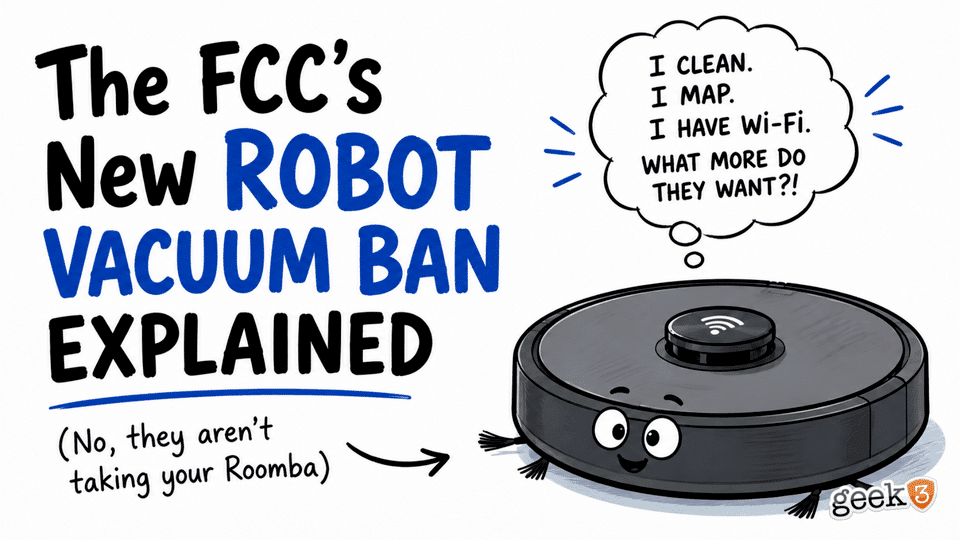
So when the FCC recently announced new restrictions affecting many future foreign-produced robot vacuums and other advanced robotic devices entering the U.S. market, it caught a lot of people off guard. Existing approved models aren’t suddenly illegal, and if you already own one, nothing changes overnight. The announcement primarily affects future products seeking approval rather than the robot vacuum that’s already cruising around your living room.
The headlines, however, made it sound like robot vacuums had suddenly become contraband.
That’s not the case.
Nobody is knocking on doors collecting Roombas. You don’t need to panic-buy a replacement, and your robot vacuum isn’t going to wake up tomorrow and refuse to clean the kitchen. If anything, the announcement is less about vacuum cleaners and more about how dramatically they’ve changed over the last decade.
That’s really the interesting part of the story.
From Bumping Into Walls to Mapping Your Home
The first generation of robot vacuums wasn’t exactly known for its intelligence. They wandered around the house like they had absolutely no plan. They’d bump into the couch, bounce off a wall, spin in circles for a while, and eventually stumble across enough of the floor to call it a successful cleaning session.
They worked, sort of. Watching one clean was almost entertainment. You never quite knew where it was going next, but somehow it usually found its way back to the charging dock.
Today’s models are in an entirely different league.
Instead of randomly wandering through your house, they build detailed floor plans. They remember which rooms they’ve already cleaned, avoid obstacles, recognize different flooring types, and let you draw virtual boundaries from an app. Some models can even identify shoes, phone chargers, pet bowls, and the occasional sock that somehow ended up in the hallway.
As much as we still call them “vacuums,” they’re really autonomous computers that happen to have brushes underneath.
That’s a pretty remarkable evolution when you think about it.
They Didn’t Just Get Better. They Got Smarter.
When most people think about a better vacuum, they imagine stronger suction or longer battery life.
Manufacturers certainly improved those things, but the biggest leap wasn’t mechanical.
It was computational.
Modern robot vacuums use technologies that would have sounded futuristic just a few years ago. Many use LiDAR, the same basic technology commonly associated with autonomous vehicles. They continuously fire harmless laser pulses around the room, measuring how long they take to bounce back. From that information, they build an incredibly accurate map of your home.
Other models combine cameras, infrared sensors, cliff sensors, bump sensors, and artificial intelligence to recognize what’s in front of them. Instead of simply running into the dog’s water bowl and hoping for the best, many can identify it before they ever get there.
It’s genuinely impressive engineering.
It’s also why today’s robot vacuum knows your home better than the old upright vacuum ever could.
In fact, some robot vacuums probably know the layout of your house better than your teenagers.
Everything Became a Computer
The robot vacuum isn’t unique.
It’s simply one of the more obvious examples of something that’s been happening for years.
Walk through your house and count how many devices are connected to Wi-Fi.
Your thermostat.
Your television.
Your security cameras.
Your garage door opener.
Your doorbell.
Your smoke detectors.
Your sprinkler controller.
Your refrigerator.
Even your coffee maker might send notifications to your phone.
We’ve reached a point where “smart” has quietly become the default setting for almost everything we buy.
That’s great from a convenience standpoint. It’s pretty amazing to tell your vacuum to clean the kitchen while you’re sitting at work.
But convenience always comes with tradeoffs.
Twenty years ago, a vacuum cleaner had a motor, a cord, and maybe a fancy HEPA filter if you were really splurging.
Today’s robot vacuum has an operating system.
That’s a very different product.
The Appliance That Never Stops Evolving
One of the strangest things about modern technology is that products don’t really stay the same after you buy them.
Remember when buying a microwave was simple? You brought it home, plugged it in, and it stayed exactly the same until it eventually wore out.
Robot vacuums don’t work like that.
Manufacturers regularly release software updates that improve navigation, add features, fix bugs, and sometimes completely change how the vacuum behaves. You might buy a robot vacuum in January and discover six months later that it’s noticeably better at avoiding obstacles than it was the day you unboxed it.
That’s something previous generations of appliances simply never did.
Imagine buying a toaster in 1995 only to receive a notification saying, “A new firmware update is available. Toasting accuracy has been improved.”
You’d think someone was playing a joke on you.
Today we barely notice.
We tap “Install Tonight” and move on with our day.
Why the FCC Cares
This is where many of the headlines skipped an important detail.
The discussion isn’t really about dirt.
It’s about data.
For a robot vacuum to do its job well, it needs to understand the space around it. That means collecting information about room layouts, obstacles, and navigation. It communicates over your Wi-Fi network, talks to cloud services, downloads updates, and in some cases stores maps that you can view from your phone.
Again, none of this is inherently bad. In fact, it’s exactly what makes these products so useful.
But it also means they’re no longer simple household appliances.
They’re connected devices.
And connected devices naturally become part of larger conversations about cybersecurity, software support, privacy, and supply chains.
Whether you agree with the FCC’s decision or disagree with it isn’t really the point of this article.
The point is that we’ve reached a place where a vacuum cleaner is sophisticated enough to be included in that conversation at all.
Twenty years ago, that sentence would have sounded ridiculous.
Today it barely raises an eyebrow.
It’s Not Just Vacuums
If we’re being honest, robot vacuums just happened to be next in line.
A few months ago, much of the discussion centered around routers. Before that it was drones. Now it’s robotic devices. Five years from now, it will probably be something else that most of us haven’t even thought about yet.
Technology has a funny way of sneaking up on us.
One day it’s a simple household gadget. The next day it’s running artificial intelligence, downloading firmware updates, connecting to cloud services, and becoming part of conversations that most people assumed were reserved for computers.
We’ve slowly stopped noticing because it happened one product at a time.
Nobody woke up one morning and decided every appliance needed Wi-Fi.
It just… happened.
One year your thermostat became smart.
The next year your garage door opener got an app.
Then your television wanted an internet connection.
Then your refrigerator started displaying weather forecasts.
Now your vacuum cleaner maps your house.
When you step back and look at it all together, it’s actually kind of incredible.
Convenience Usually Wins
Despite all of this, I don’t think smart technology is going anywhere.
Nor do I think it should.
Robot vacuums save people time.
Smart thermostats save energy.
Video doorbells help homeowners keep an eye on deliveries.
There are plenty of connected devices that genuinely improve our daily lives.
If you’ve ever owned a robot vacuum while also owning a dog that sheds enough fur to build a second dog every week, you probably understand exactly what I mean.
The convenience is real.
The goal isn’t to avoid smart devices altogether.
The goal is simply to recognize that they deserve the same level of thought we already give to our computers and phones.
Most people would never buy a laptop from a company they’ve never heard of, connect it to their network, ignore updates forever, and hope everything works out.
Yet people do something surprisingly similar with smart devices every day.
That’s changing.
Not because people are becoming paranoid.
Because connected devices have become a normal part of life.
A Few Good Habits Go a Long Way
You don’t need to become a cybersecurity expert to enjoy modern technology.
A few simple habits make a much bigger difference than most people realize.
First, keep your devices updated. Those software updates aren’t just adding new features. Many of them fix bugs, improve reliability, and patch security issues that were discovered after the product was released.
Second, buy products from companies that have a reputation for supporting what they sell. A robot vacuum is no longer just a hardware purchase. You’re also trusting the company to maintain the software for years after you bring it home.
Third, don’t connect every gadget you own simply because it gives you the option. Some products work perfectly well without cloud features enabled. Others genuinely benefit from being connected. It’s worth understanding the difference before tapping “Next” through every setup screen.
Finally, remember that smart devices are part of your home network. They may not store tax returns or family photos like your computer does, but they’re still connected equipment that deserves occasional attention.
None of this should scare anyone away from buying a robot vacuum.
It’s simply part of owning modern technology.
What This Means for Businesses
Business owners face the same challenge, just on a larger scale.
A decade ago, most office networks contained computers, printers, and maybe a server tucked away in a closet.
Today, it’s common to see smart TVs in conference rooms, internet-connected security cameras, wireless door access systems, HVAC controls, voice assistants, digital signage, and dozens of other devices sharing the same network.
Every one of those devices has software.
Every one of them needs updates.
Every one of them eventually reaches the end of its supported life.
The problem is that most businesses don’t think about those devices until something stops working.
I’ve walked into offices where people carefully maintain every computer but have security cameras that haven’t received an update in years. I’ve seen wireless access points that nobody remembers installing, smart televisions connected to guest networks with default settings, and conference room equipment that hasn’t been touched since the day it came out of the box.
It’s not because anyone was careless.
It’s because these devices don’t look like computers.
But under the hood, that’s exactly what they are.
The robot vacuum story is really just another reminder that the definition of “computer” has changed dramatically.
The Bigger Picture
Whether the FCC’s latest decision ultimately changes the robot vacuum market remains to be seen. Manufacturers will adapt, new products will arrive, and technology will continue moving forward, just as it always has.
What won’t change is the direction we’re heading.
More appliances will become connected.
More products will rely on software.
More everyday devices will use artificial intelligence.
And more conversations that once centered around computers will begin involving products we never expected.
If someone had told me twenty years ago that a vacuum cleaner would someday receive firmware updates, build a digital map of my home, avoid my dog’s toys using AI, and become part of a national technology discussion, I would have assumed they had watched one too many science fiction movies.
Now it’s just another Tuesday.
That’s probably the most interesting part of this entire story.
The FCC announcement isn’t really about vacuum cleaners.
It’s a reminder of how much technology has changed the ordinary objects we use every single day.
And honestly… I still think it’s a little funny that one of the smartest computers in some homes spends most of its day chasing dust bunnies under the couch.
Need Help Keeping Your Technology Under Control?
Whether it’s computers, servers, Wi-Fi, security cameras, Microsoft 365, or the growing collection of smart devices connected to your business, technology is becoming more complicated every year. The good news is that you don’t have to keep up with all of it yourself.
At Geek3, we help businesses throughout North Central Florida manage, secure, and support the technology they rely on every day. If you have questions about your network, cybersecurity, or simply want someone to make sure everything is working the way it should, I’d be happy to help.
Feel free to reach out. I’d love to chat.
