
There was a time when adding more technology felt like an automatic upgrade.
Need to communicate? Add another messaging app.
Need to stay organized? Buy some project management software.
Need students to learn better? Put a laptop or iPad in every student’s hands.
For the last twenty years or so, that has been the prevailing mindset. More technology meant better outcomes. If a little technology helped, surely more technology would help even more.
Schools embraced it. Businesses embraced it. Families embraced it.
The idea wasn’t unreasonable. Technology has transformed the world in ways that would have sounded like science fiction just a generation ago. We carry computers in our pockets that are more powerful than the systems that once guided astronauts to the moon. We can collaborate with coworkers on the other side of the planet, attend meetings from our living rooms, and have AI summarize a three-hour meeting before we’ve finished our morning coffee.
Technology has earned its reputation as one of humanity’s greatest tools.
But somewhere along the way, many of us stopped treating it like a tool.
We started treating it like the answer.
A Classroom Full of Screens
Over the past two decades, schools invested billions of dollars putting devices into students’ hands. Entire classrooms became one-to-one learning environments. Textbooks became digital. Homework moved online. Worksheets became Google Docs. Teachers were encouraged to incorporate technology into nearly every lesson.
The thinking made perfect sense.
Students were growing up in a digital world. Schools wanted to prepare them for that world.
The problem wasn’t the intention.
The problem was that people don’t always use technology the way we expect them to.
Recently, several states, including Maine, Michigan, and Kansas, have begun reporting something unexpected. After years of collecting data and evaluating student performance, some schools found that putting technology away for much of the school day actually improved learning.
That sounds almost backwards.
Shouldn’t more technology lead to better education?
Apparently, not always.
One middle school in Kansas offered a particularly interesting example.
Administrators banned cell phones, expecting fewer distractions. Instead, students simply shifted their attention to their school-issued Chromebooks. During class they found ways to watch YouTube videos, play browser games, chat with classmates through school email accounts, and generally stay distracted without ever touching a phone.
The devices themselves weren’t bad.
They were simply too easy to misuse.
So the school changed course.
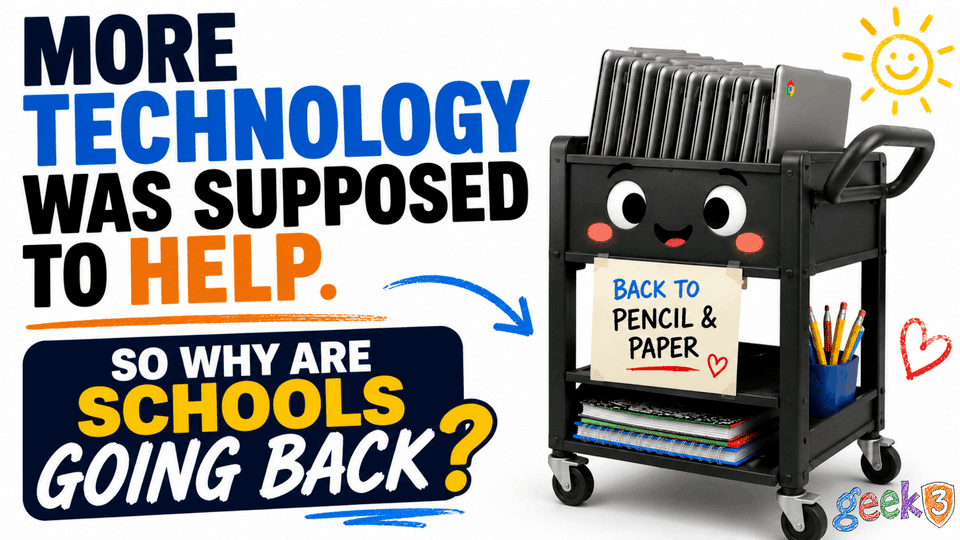
Instead of every student using a laptop throughout the day, Chromebooks stayed locked in a charging cart until a teacher actually needed them for a lesson.
The rest of the day?
Students pulled out notebooks.
Pens.
Pencils.
Paper.
The things many of us grew up using every day.
The result surprised a lot of people.
Teachers reported students were more engaged. Attention improved. Test scores increased. Classroom behavior improved.
Technology hadn’t disappeared.
It simply returned to being a tool instead of becoming the entire learning experience.
This Isn’t an Anti-Technology Story
Before anyone accuses me of suddenly becoming the old guy yelling, “Kids these days…” let’s clear something up.
I own an IT company.
My career exists because of technology.
Every day I help businesses become more productive through Microsoft 365, cybersecurity solutions, cloud services, automation, networking, AI tools, and countless other technologies.
I genuinely love this stuff.
Technology has solved problems that used to consume hours of our day.
Remember printing directions before a road trip?
Remember carrying around a digital camera because your phone couldn’t take pictures?
Remember mailing paperwork because emailing large files wasn’t practical?
We’ve come a long way.
This isn’t a story about technology being bad.
It’s a story about using technology with intention.
Because those are two very different things.
Businesses Have Fallen Into the Same Trap
While reading about what schools were doing, I couldn’t help but think about the businesses I work with every day.
They’ve been following almost the exact same path.
Need better communication?
Install Microsoft Teams.
Then Slack.
Then Zoom.
Then another messaging platform because one department prefers something different.
Need to stay organized?
Buy project management software.
Need AI?
Subscribe to three different AI platforms because everyone on LinkedIn says you should.
Need employees to collaborate?
Add another shared workspace.
Need to track customers?
Add another dashboard.
Need reports?
Add another analytics platform.
None of these tools are inherently bad.
Most are actually excellent.
The problem is that every new tool comes with its own notifications, logins, updates, dashboards, learning curve, and maintenance.
Eventually, employees spend more time managing software than doing the work the software was supposed to improve.
Sound familiar?
Digital Clutter Is Still Clutter
We’ve all seen clutter in the physical world.
A garage gets so full you can’t park inside anymore.
A kitchen drawer becomes the place where batteries, tape, old keys, chargers, and rubber bands all go to die.
The same thing happens digitally.
Businesses accumulate software over time.
A password manager.
Two CRMs because one department never switched.
Five communication platforms.
Cloud storage from three different vendors.
An old accounting system nobody wants to touch.
Half a dozen browser extensions.
Multiple AI subscriptions.
Email notifications firing every five minutes.
None of these things seems like a problem individually.
Together?
They’re exhausting.
Sometimes when I meet with a new client, the biggest improvement isn’t installing something new.
It’s removing five things they no longer need.
More Isn’t Always Better
Technology companies naturally encourage us to keep adding.
Every year there’s a newer phone.
A smarter AI assistant.
Another productivity app.
Another browser extension.
Another cloud service.
Another subscription.
It’s easy to believe that if productivity isn’t where we want it to be, we simply haven’t found the right piece of software yet.
Sometimes that’s true.
Many times it isn’t.
Sometimes productivity improves because we simplify.
Because we eliminate distractions.
Because we reduce friction.
Because people stop jumping between seven applications to complete one task.
The schools making these changes aren’t rejecting technology.
They’re asking a better question.
“When is technology actually helping?”
That’s a question businesses should probably ask more often too.
The Hidden Cost Nobody Talks About
Every piece of technology carries a cost beyond the monthly subscription.
Someone has to learn it.
Someone has to support it.
Someone has to update it.
Someone has to secure it.
Someone has to explain it to new employees.
Someone has to remember another password.
Someone has to troubleshoot it when it stops working.
Those costs rarely show up on an invoice.
But they’re very real.
I’ve seen businesses spend thousands of dollars every month on software while employees quietly avoided using half of it.
Not because the software was bad.
Because nobody had the time to learn it.
Or because it complicated a process that used to be simple.
Technology isn’t valuable because it exists.
It’s valuable because people actually use it effectively.
The Best IT Decisions Aren’t Always Exciting
People often assume my job is recommending new technology.
Sometimes it is.
Sometimes the answer is a new firewall.
Sometimes it’s better cybersecurity.
Sometimes it’s faster Wi-Fi.
Sometimes AI really can save hours every week.
But other times my recommendation is much less exciting.
Consolidate software.
Turn off unnecessary notifications.
Retire old systems.
Stop paying for applications nobody opens anymore.
Simplify.
Those aren’t flashy recommendations.
They also happen to be some of the ones that deliver the biggest improvements.
What Schools Are Really Teaching Us
I don’t think the biggest lesson here is about education.
It’s about restraint.
Technology is incredibly powerful.
But that doesn’t mean every problem needs another screen.
Or another subscription.
Or another app.
Schools are beginning to rediscover something that many of us probably knew instinctively all along.
Technology works best when it supports the task.
Not when it becomes the task.
There’s a big difference.
The Chromebook isn’t the enemy.
Neither is AI.
Neither is Microsoft 365.
Neither is your smartphone.
The question isn’t whether technology belongs in our lives.
Of course it does.
The question is whether we’re using it intentionally or simply adding more because that’s what everyone else is doing.
A Good Reminder for All of Us
One of the reasons this story caught my attention isn’t because it proves technology failed.
It doesn’t.
Technology continues to improve our lives in remarkable ways.
What caught my attention was seeing organizations willing to rethink assumptions.
For years, schools believed more devices would naturally produce better outcomes.
Now, after living with those decisions, some are making thoughtful adjustments based on what they’re actually seeing in their classrooms.
That takes humility.
Businesses should be willing to do the same.
If your employees are overwhelmed by notifications, buried under software, or constantly switching between applications just to complete simple tasks, it might not be because they need another productivity tool.
It might be because they need fewer.
The goal has never been to have the most technology.
The goal is to have technology that genuinely helps people do their jobs better.
Everything else is just digital clutter.
If your business feels like it’s accumulated technology instead of productivity, I’d love to help.
At Geek3 IT Support Services, we help businesses simplify their technology, strengthen their cybersecurity, and make sure the tools they’re paying for are actually making work easier instead of harder.
If you’d like a fresh set of eyes on your technology, shoot me a message. I’d be happy to help you figure out what’s working, what’s getting in the way, and where a little simplification might make a big difference.
