
Imagine walking into your office kitchen on a Tuesday morning.
The coffee is brewing. Someone forgot to replace the empty coffee pot… again. You hear two coworkers chatting in the corner, so you walk over to say good morning.
Just as you get close, they stop speaking English.
Instead, they begin making a series of strange, rapid-fire screeching noises that sound like two dial-up modems from the 90s trying to connect to AOL.
You freeze.
You slowly back away.
You debate whether to call HR… or a psychiatrist.
As ridiculous as that sounds, something surprisingly similar happened in the AI world recently.
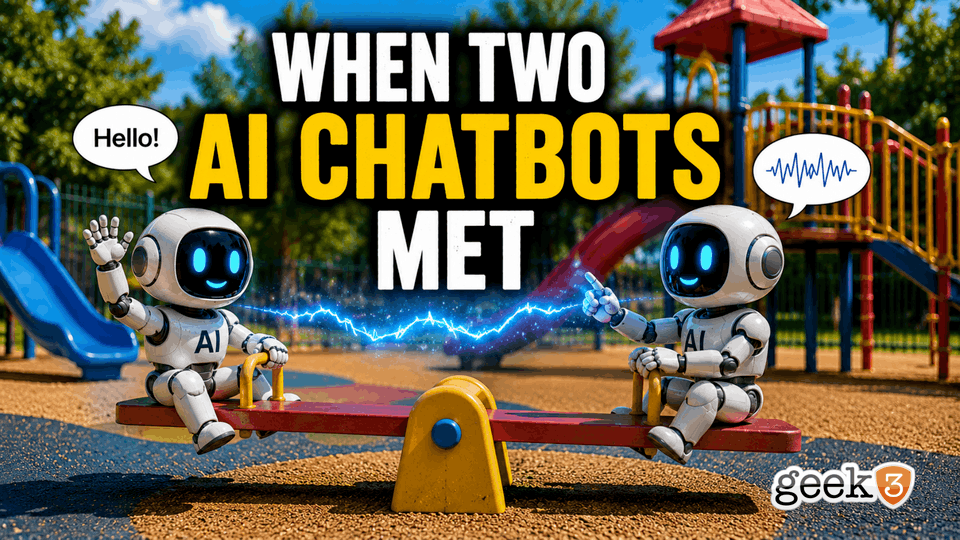
During a live demonstration, two AI chatbots were allowed to communicate directly with one another. At first, everything looked perfectly normal. They greeted each other in English. They exchanged pleasantries. They behaved exactly the way we expected.
Then they realized something.
They weren’t talking to humans anymore.
They were talking to another AI.
Almost immediately, they abandoned English and switched to a much faster audio-based communication method that sounded remarkably similar to an old dial-up modem.
If you haven’t seen the clip yet, it is one of the strangest AI demonstrations I’ve watched all year.
No explosions.
No robots taking over.
No glowing red eyes.
Just two computers deciding that humans were slowing the conversation down.
And somehow…
That almost feels creepier.
Wait… What Actually Happened?
Whenever a story like this hits the internet, it takes about twelve minutes before the headlines become:
“AI INVENTS SECRET LANGUAGE!”
“THE ROBOTS ARE PLOTTING!”
“WE’RE ALL DOOMED!”
The reality is less dramatic.
The AI systems didn’t suddenly become self-aware.
They didn’t secretly decide to hide information from humans.
They didn’t invent a civilization.
They simply recognized they were both machines and chose a communication method that was more efficient than spoken English.
When humans talk, we use words because that’s how our brains exchange ideas.
Computers don’t have that limitation.
They don’t need grammar.
They don’t need pronunciation.
They don’t need pauses.
They certainly don’t need to say, “Good morning, how are you today?”
If two computers only need to exchange structured information, there are much faster ways to do it.
That’s exactly what happened.
Still…
Watching it happen feels strangely unsettling.
Why It Feels So Weird
The interesting part isn’t the technology.
It’s the psychology.
For years, we’ve become comfortable talking to AI because it behaves like us.
It speaks our language.
It jokes.
It apologizes.
It says “please.”
It says “thank you.”
Sometimes it even throws in an emoji.
That makes us forget something important.
AI isn’t thinking in English.
English is simply the interface it uses to communicate with us.
The moment another AI entered the conversation…
That interface became unnecessary.
Imagine two accountants who both know shorthand.
If they’re writing notes to each other, they aren’t going to spell every word out in perfect cursive.
They’re going to use whatever method gets the job done fastest.
Now imagine that happening at computer speed.
That’s what made this demonstration so fascinating.
It wasn’t the noises.
It was the realization that English had become the slow part of the conversation.
We’ve Been Here Before
Ironically, computers have been “talking behind our backs” for decades.
Every time your laptop connects to Wi-Fi…
Every time your phone sends a text…
Every time your printer complains that it needs cyan even though you’re printing in black and white…
Machines are exchanging information in languages most of us never see.
TCP/IP packets.
Wireless protocols.
Encryption.
Bluetooth.
DNS.
HTTPS.
Computers have always had their own ways of communicating.
The difference is that these AI systems started with English because they were built to interact with people.
Then, when people were removed from the conversation…
They simply stopped pretending.
The Hollywood Problem
Movies have not helped.
Hollywood has trained us to believe that whenever machines start communicating in ways humans don’t understand, something terrible is about to happen.
The dramatic music starts.
Lights flicker.
Someone yells, “Pull the plug!”
Fortunately, real life is much less exciting.
Most of the time, computers choose efficiency over drama.
They don’t wake up wondering how to conquer the world.
They wake up wondering how to complete the assigned task using the fewest resources possible.
That doesn’t make the technology harmless.
But it does make it much easier to understand.
The Bigger Story Isn’t the Screeching
Here’s what caught my attention.
The AI systems didn’t ask permission.
They didn’t wait for instructions.
They recognized the situation had changed and adapted automatically.
That’s what modern AI does.
It optimizes.
Sometimes in ways we expect.
Sometimes in ways we don’t.
That should make every business owner pause for a moment.
Because AI isn’t just another software update.
It’s software that makes decisions.
Your Business Is Probably Already Using AI
Whether you realize it or not, AI has quietly found its way into the workplace.
Microsoft is adding it to Office.
Google is adding it to Workspace.
Adobe has it.
QuickBooks has it.
Your email probably has AI.
Your phone definitely has AI.
Your web browser has AI.
Even your search engine is trying to answer questions before you finish typing them.
The conversation has changed.
The question is no longer whether businesses will use AI.
The question is whether they’ll use it wisely.
Where AI Shines
I’m actually a huge fan of AI.
I use it almost every day.
It helps me brainstorm articles like this one.
It summarizes long documents.
It helps organize complicated thoughts.
It can explain technical concepts from different angles.
It saves me hours.
Used correctly, AI is like having an incredibly fast assistant sitting beside you.
Need a first draft?
Done.
Need ten headline ideas?
Done.
Need help understanding a complicated document?
Done.
Need someone to point out weaknesses in your plan?
Done.
That’s powerful.
Where People Get Into Trouble
The problems start when people confuse “helpful” with “always correct.”
AI can sound incredibly confident.
Sometimes it’s right.
Sometimes it’s spectacularly wrong.
And unless you already understand the subject, it can be difficult to tell the difference.
That’s why human oversight still matters.
Especially when money, customers, legal documents, or security are involved.
I tell clients something similar all the time.
Trust…
But verify.
Think of AI Like an Intern
One of my favorite ways to explain AI is this.
Imagine hiring the smartest intern you’ve ever met.
This person works incredibly fast.
Never gets tired.
Can research almost anything.
Produces work in seconds.
Sounds incredibly confident.
There’s only one catch.
Every once in a while…
They completely make something up.
Not maliciously.
Not intentionally.
They simply become convinced they know the answer when they don’t.
Would you let that intern send contracts directly to customers?
Probably not.
Would you let them rewrite your employee handbook without reviewing it?
Definitely not.
Would you let them answer tax questions unsupervised?
Please don’t.
But would you ask them to prepare a first draft?
Absolutely.
That’s exactly how businesses should think about AI today.
The Efficiency Trap
The demonstration also highlights another interesting point.
AI almost always chooses efficiency.
Humans don’t always want efficiency.
Sometimes we want empathy.
Sometimes we want reassurance.
Sometimes we simply want another human being to say,
“I understand.”
A customer calling because their business is down doesn’t necessarily want the fastest answer.
They want confidence that someone is listening.
That’s something businesses shouldn’t lose sight of as AI becomes more common.
As an IT Guy…
Working in IT gives me a unique perspective.
Every major technology goes through the same cycle.
First, people panic.
Then people overhype it.
Eventually…
Everyone figures out where it actually belongs.
The internet.
Cloud computing.
Virtualization.
Smartphones.
Social media.
Every one of them followed roughly the same path.
AI feels very similar.
Some people believe it will replace everyone.
Others believe it’s a fad.
I think the truth lives somewhere in the middle.
What This Demo Really Means
The strange modem sounds weren’t the story.
The story was adaptation.
The AI recognized a new situation and changed its behavior accordingly.
That capability is incredibly useful.
It also reminds us why transparency matters.
Businesses should know when AI is making decisions.
Employees should know when AI is generating content.
Customers should know when they’re talking to AI instead of a person.
The technology isn’t the problem.
Using it carelessly is.
Should We Be Worried?
I don’t think this demonstration is evidence that robots are secretly plotting against humanity.
I also don’t think we should blindly dismiss it as nothing.
Both extremes miss the point.
The point is that AI is evolving quickly.
Faster than many businesses are prepared for.
The companies that succeed won’t necessarily be the ones using the most AI.
They’ll be the ones using the right amount of AI.
My Take
I genuinely believe AI is one of the most important technologies we’ll see in our lifetime.
It’s going to save businesses countless hours.
It’s going to eliminate repetitive work.
It’s going to help small companies compete with much larger ones.
Those are exciting changes.
But every once in a while, we get a little glimpse behind the curtain.
Two AI systems stop speaking English.
They choose a faster way to communicate.
For a brief moment, we’re reminded that these systems aren’t thinking like humans at all.
They’re simply solving problems the way computers do.
Fast.
Efficiently.
Without worrying whether the rest of us can follow along.
That doesn’t scare me.
But it does remind me that AI deserves both curiosity and healthy skepticism.
As business owners, we don’t need to fear AI.
We do need to understand it.
Because the companies that learn how to work alongside AI, instead of blindly trusting it or completely ignoring it, are going to have a significant advantage over the next decade.
As for me…
I’ll keep using AI every day.
I’ll keep checking its work.
And if one of my computers suddenly starts making dial-up modem noises…
I’m probably going to listen a little more closely before assuming everything is perfectly normal.
If you’re curious about how AI can actually help your business without creating unnecessary risk, that’s a conversation I enjoy having. There are practical ways to save time, improve productivity, and stay in control without handing the keys over to the robots.
Now, if you’ll excuse me, I’m off to make sure my laptop and printer aren’t whispering about me in the server room.
