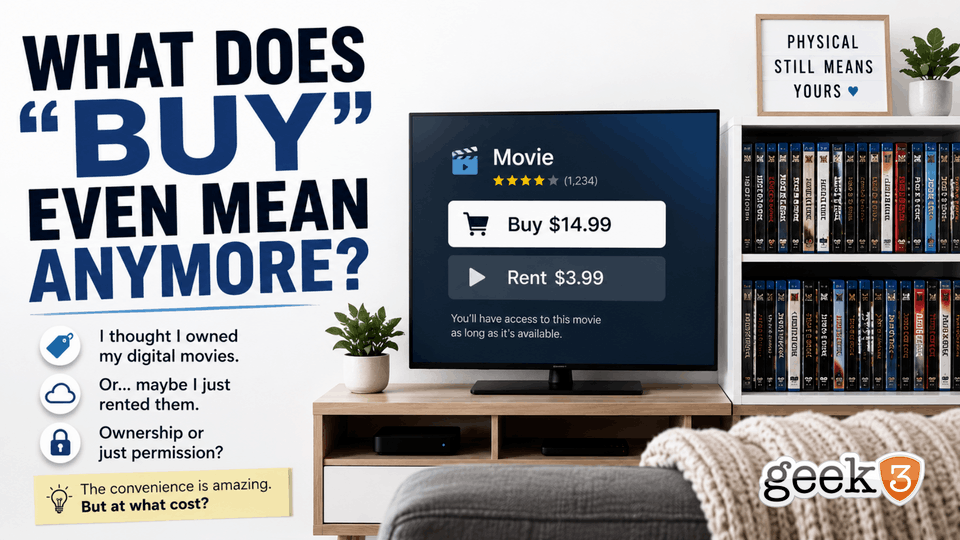

What Does “Buy” Even Mean Anymore?
I own 253 movies in my Google library.
Or… maybe I just rented them without realizing it.
Before anyone judges me, I almost never pay full price. I’m one of those people who wait until a movie drops to $4.99 before buying it. It’s become a little hobby of mine. (Also… having two daughters means a suspicious percentage of those movies involve talking animals.)
Every time I clicked the Buy button, I assumed I was doing exactly that.
Buying a movie.
Adding it to my collection.
Something I could watch whenever I wanted for years to come.
Then I came across a story that made me stop and think.
Sony recently announced that hundreds of movies and TV shows will disappear from customers’ PlayStation libraries as licensing agreements expire. People who paid for those movies years ago may soon discover they no longer have access to them.
Now, this article isn’t really about Sony.
Sony just happened to ask a question that I don’t think most of us have ever stopped to consider.
What does “buy” actually mean anymore?
When I was growing up, buying something was refreshingly uncomplicated.
You went to the store.
You picked it up off the shelf.
You paid.
You went home.
End of story.
If the store closed six months later, your purchase didn’t suddenly evaporate.
Nobody knocked on your door asking for your VHS collection back because Blockbuster lost a contract.
Your Nintendo games still worked.
Your CDs still played.
Your DVD collection didn’t mysteriously shrink overnight because two companies had a disagreement in a conference room.
Ownership felt… permanent.
Predictable.
Boring, even.
And that’s exactly what made it great.
As someone who works in IT, I’ve watched this change happen little by little over the last twenty years.
At first, we bought software.
Microsoft Office came in a box.
Adobe Photoshop came in a box.
QuickBooks came in a box.
You installed it.
Maybe you upgraded every few years.
Maybe you didn’t.
But nobody expected Word to stop opening because Microsoft changed a licensing agreement.
Then subscriptions arrived.
Microsoft 365.
Adobe Creative Cloud.
Cloud backups.
Password managers.
Antivirus.
Accounting software.
Everything slowly shifted from ownership to ongoing access.
Most of us accepted the tradeoff because there were real benefits.
Continuous updates.
Better security.
Cloud syncing.
New features.
Support.
In many ways, subscriptions genuinely made software better.
But while software was changing, something else was changing too.
Movies.
Music.
Books.
Games.
Almost without noticing, we stopped collecting things.
We started collecting access.
The funny thing is…
I don’t think most people realize that’s what happened.
If I asked ten people whether they “own” their Netflix movies, they’d laugh.
Of course not.
It’s a subscription.
But ask those same people whether they own the movies they purchased on Apple TV, Amazon, Google, or another online store…
I think most would confidently answer…
“Yes.”
I’m not so sure anymore.
One thing I found fascinating while reading comments about the Sony story was what people weren’t arguing about.
They weren’t debating copyright law.
They weren’t discussing legal definitions.
Most people didn’t seem interested in whether Sony technically had the contractual right to remove those titles.
Instead, they kept asking a much simpler question.
If there’s a Rent button and a Buy button… shouldn’t those words mean different things?
Honestly…
I think that’s the entire story.
Forget Sony for a minute.
Imagine walking into a furniture store.
One couch says:
Rent – $99/month
The one beside it says:
Buy – $1,500
You know exactly what those words mean.
One is temporary.
One is yours.
Now imagine paying the $1,500.
Three years later, someone rings your doorbell.
“We’re sorry, but our agreement with the couch manufacturer expired.”
I don’t think anyone would calmly say…
“Ah, yes… subsection 14.2 of the end-user license agreement.”
No.
They’d say…
“I bought the couch.”
Because that’s how normal people understand the word.
Obviously, movies are different.
Nobody believes buying a movie gives them ownership of the copyright.
Nobody thinks they suddenly become a part-owner of the film studio.
That’s not the expectation.
The expectation is much simpler.
If I paid for it once… I should still be able to watch it later.
That’s really what people mean when they say they “own” a digital movie.
They’re talking about permanence.
Not copyright.
Not legal definitions.
Just permanence.
That realization changed how I looked at the whole conversation.
Maybe this isn’t really about ownership.
Maybe it’s about certainty.
Think about it.
Why are vinyl records making a comeback?
Why are people buying Blu-rays again?
Why are some people rebuilding DVD collections?
I don’t think it’s because anyone misses rewinding tapes or searching through binders.
I think people miss certainty.
They miss knowing that tomorrow will look exactly like today.
If the internet goes down…
The movie still works.
If the company disappears…
The movie still works.
If licensing changes…
The movie still works.
There’s something comforting about that.
Ironically…
I have no desire to go back.
I love digital libraries.
I love sitting on the couch and instantly finding a movie.
I love that my daughters can search for a movie without asking me where the DVD case is.
I love not having shelves filled floor-to-ceiling with plastic cases.
Technology has made this incredibly convenient.
But convenience almost always comes with a tradeoff.
Sometimes that tradeoff is obvious.
Sometimes it hides in plain sight.
Cloud storage is convenient.
But your files live on someone else’s servers.
Microsoft 365 is convenient.
But stop paying, and things change.
Streaming music is convenient.
But songs come and go.
Digital movie libraries are convenient.
But stories like this remind us that convenience isn’t always the same thing as permanence.
One of my favorite analogies is renting a storage unit.
Imagine you spend years carefully filling it.
Family photos.
Furniture.
Holiday decorations.
Boxes of memories.
One day, you pull up and discover the building has been demolished.
The owner shrugs and says,
“Don’t worry. You still own your belongings.”
Technically…
Sure.
But that’s not very helpful if you can’t access them anymore.
Access matters.
Sometimes access is the thing we actually value most.
I also started thinking about all the words we’ve quietly allowed technology to redefine.
Friend.
Cloud.
Wireless.
Unlimited.
Lifetime.
Now…
Buy.
The meanings aren’t necessarily wrong.
They’re just… different.
Different enough that millions of people still interpret them the old way.
Another thing struck me while reading discussions online.
People kept asking whether this would justify piracy.
Personally, I don’t think that’s the interesting question.
It’s certainly the loudest question.
But not the most interesting one.
The better question is…
Should companies be clearer about what customers are actually purchasing?
If it’s really a long-term license that could eventually disappear…
Should the button still say Buy?
Or should it say something else?
Maybe “Purchase a license.”
Maybe “Permanent Access.”
Maybe something we’ve never thought of before.
I don’t know the answer.
But I do know language shapes expectations.
If I buy a plane ticket, I don’t expect to own the airplane.
The product is transportation.
The wording matches the expectation.
With digital media…
I’m not convinced the wording and the expectation still match.
Here’s the part that hit closest to home.
I found myself opening my Apple TV library.
Two hundred fifty-three movies.
There they all were.
Exactly where I left them.
And for the first time…
I asked myself a question I’d never considered.
What if they weren’t?
Not because I think Apple is about to delete my collection.
I don’t.
Apple has generally done an excellent job supporting digital purchases.
But that’s not really the point.
The point is that I’d never even considered the possibility before.
The Sony story didn’t make me distrust Apple.
It made me realize I’d never questioned the assumption behind the word Buy.
Maybe that’s why this story spread so quickly.
It wasn’t really about Sony.
It wasn’t even really about movies.
It was about realizing that one of the oldest words in commerce may no longer mean what most people think it means.
Technology didn’t ask our permission.
It just quietly changed the definition while we were busy enjoying the convenience.
And honestly…
I still love the convenience.
I’ll probably keep buying movies when they drop to $4.99.
I’ll probably keep adding suspiciously large numbers of animated movies to my library.
But I’ll also probably look at that Buy button a little differently from now on.
Not with fear.
Not with anger.
Just with a better understanding of what I may actually be purchasing.
Maybe that’s the real takeaway.
Technology isn’t making ownership disappear.
It’s redefining it.
And whether we agree with that or not…
It’s probably worth understanding before we click Buy again.
Technology changes every day, and sometimes the biggest lessons aren’t about artificial intelligence, cybersecurity, or the latest gadget. Sometimes they’re about taking a step back and asking whether the words we’ve trusted for decades still mean what we think they do.
If your business is looking for a trusted IT partner to help navigate today’s rapidly changing technology landscape, I’d love to help. Whether it’s cybersecurity, software licensing, cloud services, or simply making sense of the latest tech trends, feel free to send me a message. I’d be happy to help.
