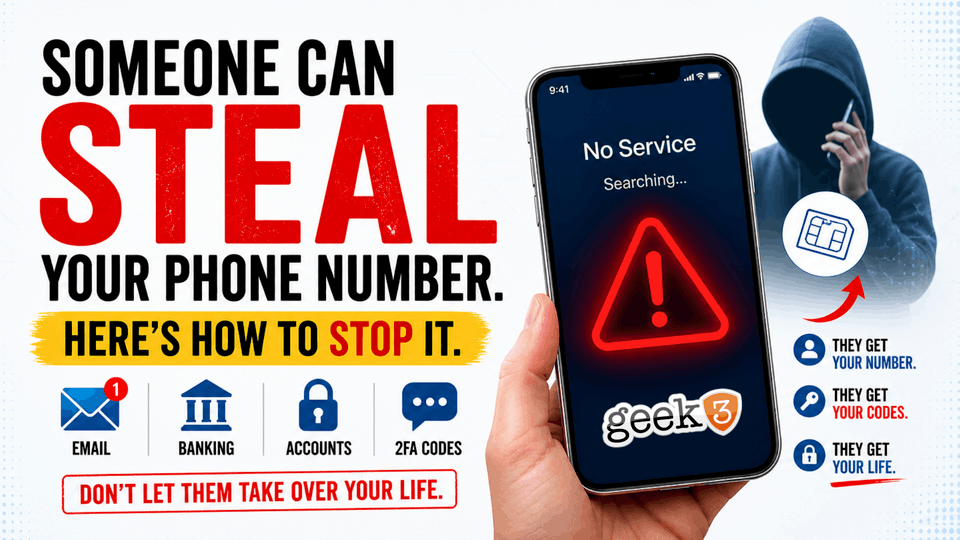

Let me paint you a quick picture.
Your phone suddenly says “No Service.”
No bars. No data. Nothing.
You do what everyone does. Toggle airplane mode. Restart the phone. Maybe glance at your WiFi like it somehow betrayed you.
Still nothing.
So you shrug it off.
“Carrier issue,” you think.
Meanwhile… someone else just picked up your phone number and is now receiving your text messages.
Not a glitch.
Not bad coverage.
A scam.
This Isn’t Some Advanced Hack
When people hear about cybersecurity issues, they tend to imagine something complicated.
Lines of code.
Exploits.
Some guy in a hoodie working magic from across the world.
That’s not what this is.
This is simple.
It’s called a port-out scam, and it works because it doesn’t attack your phone.
It attacks the process.
What a Port-Out Scam Actually Is
Every phone number can be moved from one carrier to another.
This is called “porting.”
It’s a legitimate process. People switch carriers all the time. You keep your number, move to a new provider, and everything just works.
That convenience is exactly what scammers abuse.
Here’s what happens:
- A scammer pretends to be you
- They contact your cell phone carrier
- They request to move your number to a new carrier or SIM
- The carrier approves it
That’s it.
Once that request goes through:
- Your phone loses service
- Their phone gains your number
From that moment forward, they are effectively you… at least as far as text messages are concerned.
Why Your Phone Number Matters More Than You Think
Ten years ago, your phone number was just… your phone number.
Now?
It’s a key.
It unlocks your email.
It unlocks your bank.
It unlocks your password resets.
It’s tied into nearly every important account you have.
Think about how many times you’ve seen this:
“We’ll send you a code to verify it’s you.”
That code goes to your phone number.
So if someone else has your number… they have your codes.
The Domino Effect
This is where things get ugly.
Once a scammer controls your phone number, they don’t stop there.
They start with the easiest wins:
- Reset your email password
- Use that email to reset other accounts
- Trigger two-factor authentication codes
- Access banking or financial platforms
From there, it snowballs.
Your email gets locked.
Your accounts start getting accessed.
Your financial platforms may be exposed.
And because they control your phone number, they can intercept the very alerts that would normally warn you.
A Simple Analogy
Imagine someone walks into a car dealership and convinces them to hand over your car keys.
No broken windows.
No alarms going off.
Just a convincing story and enough personal information to sound legitimate.
They drive away.
Later, you walk outside and your car is gone.
That’s this scam.
Except instead of your car, it’s your digital identity.
This Is a People Problem, Not a Technology Problem
Here’s the uncomfortable truth.
This isn’t about hacking systems.
It’s about convincing people.
These attacks usually involve:
- Basic personal information (often from data breaches)
- A phone call or chat with a carrier rep
- A confident story
- A little persistence
That’s all it takes.
Because at some point, a human being is deciding whether to approve that request.
And humans can be convinced.
“But My Carrier Would Never Let That Happen”
They can.
And sometimes they do.
Not because they’re careless, but because:
- They’re trying to help customers quickly
- They’re dealing with high call volumes
- They’re trained to resolve issues, not suspect every caller
Most carriers have added safeguards over time.
But safeguards only work if they’re enabled… and if they’re followed.
There Are Two Versions of This Attack
It’s worth calling this out, because people often confuse them.
1. Port-Out Fraud
This is what we’ve been talking about.
- Your number gets moved to a different carrier
- Your phone loses service entirely
2. SIM Swap
This is slightly different:
- Your number stays with the same carrier
- It gets moved to a different SIM card
Same end result.
Someone else gets your texts.
Why This Is Happening More Often
You’re not imagining it. These attacks have been picking up.
There are a few reasons:
1. Data Is Everywhere
Thanks to years of data breaches, attackers can often find:
- Your name
- Your phone number
- Your email
- Sometimes even partial SSNs
That’s more than enough to sound convincing.
2. SMS Is Still Everywhere
Despite better security options existing, many systems still rely on text message verification.
It’s easy. It’s familiar. It’s widely supported.
It’s also a single point of failure.
3. It Works
This isn’t a theoretical attack.
It works.
And because it works, it gets reused.
The Good News
This is one of the rare cases where:
- The threat is real
- The damage can be significant
- And the prevention is actually straightforward
You don’t need to be technical.
You just need to turn on the right protections.
How to Protect Yourself
Here’s the part that actually matters.
Take a few minutes and lock this down with your carrier.
AT&T
- Open the AT&T app or website
- Go to Profile → People & Permissions
- Set a strong account passcode
- Do not generate a Number Transfer PIN unless you are actively porting
What matters:
Your protection is tied to your account security. If someone can access or manipulate your account, they can generate a transfer PIN.
Verizon
- Open the My Verizon app
- Go to Account → Security Settings
- Turn on Number Lock for each line
- Set or update your account PIN
What matters:
Number Lock is one of the strongest protections available. If it’s off, turn it on.
T-Mobile
- Log into your account
- Go to Profile → Line Settings
- Enable Port-Out Protection
- Set a strong account PIN
What matters:
Protection exists, but it’s not always enabled by default.
Everyone
Stop relying only on text messages for security.
Use an authenticator app instead:
- Google Authenticator
- Microsoft Authenticator
If your phone number is the key… this scam has the key.
The Warning Sign Most People Miss
Here’s the part almost nobody thinks about.
If your phone suddenly loses service…
…and it doesn’t come back quickly…
Don’t ignore it.
That might be your only early warning sign that something is wrong.
What To Do If It Happens
If you ever suspect this:
- Contact your carrier immediately
- Tell them you believe your number has been ported or SIM swapped
- Lock down your account
- Start securing your email and financial accounts
Speed matters here.
The faster you react, the more you limit the damage.
Why This Matters for Businesses
If you’re running a business, this risk multiplies.
Now it’s not just your personal accounts.
It’s:
- Business email
- Financial systems
- Client communications
- Internal tools
All tied, in some way, back to your phone number.
One compromised number can turn into a much larger problem.
Final Thought
Most people assume problems like this require something complicated to fix.
They don’t.
This is one of those situations where:
A simple setting…
that takes a few minutes…
can prevent a very real problem.
Take the time to do it.
Because this is the kind of thing that only shows up after it’s already caused damage.
A Quick Note
This is the kind of issue most businesses don’t think about… until it’s a problem.
We help clients stay ahead of things like this every day.
If you’re not sure where your gaps are, let’s fix that.
